
AI Creates a New Role: The GTM Engineer
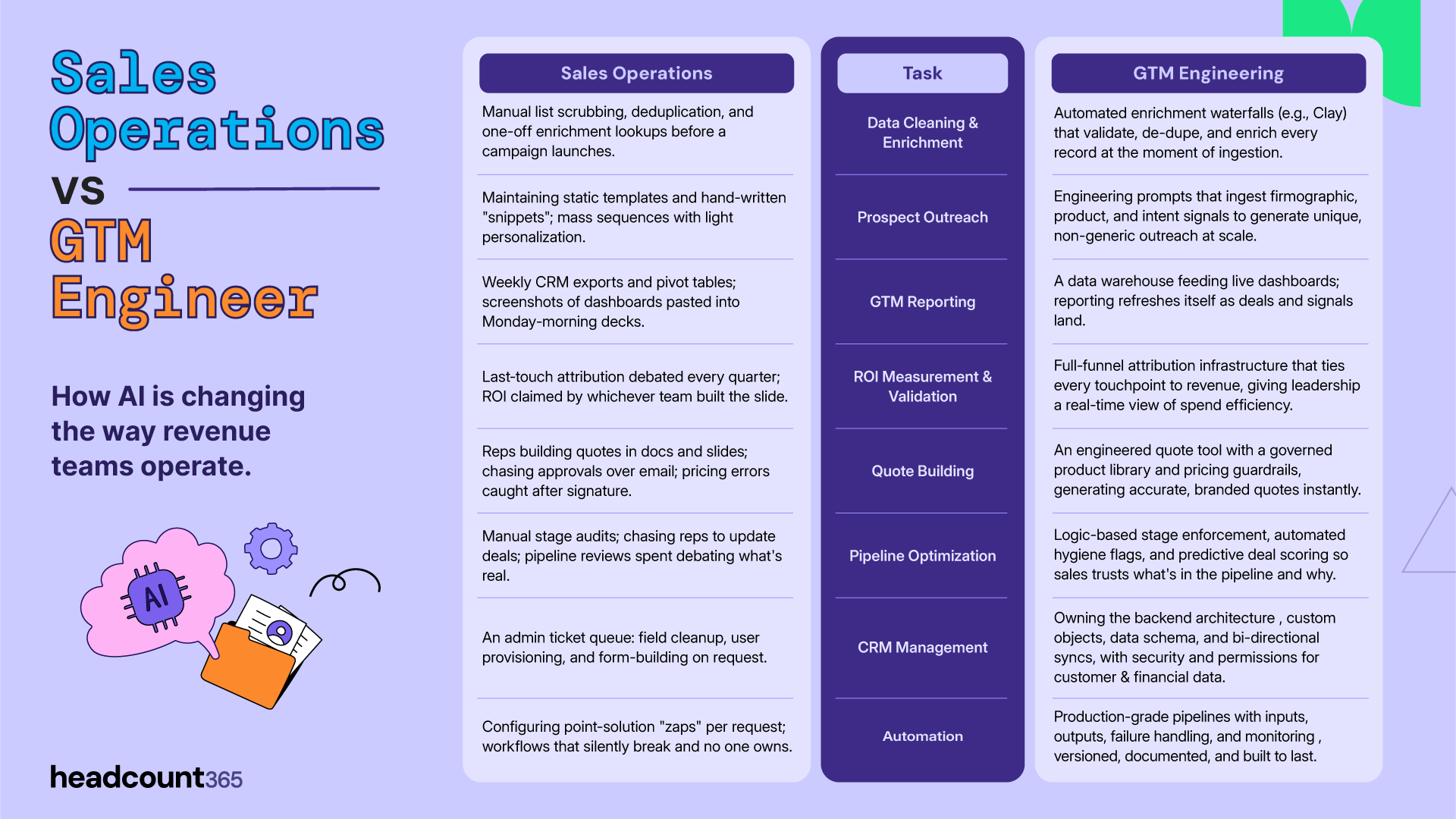
Table of Contents
How AI impacts sales operations & enablement
The Sales Operations role is changing because of AI. As part of a series about AI’s impact on the org chart, we’re covering the evolution of sales and revenue operations & enablement. What used to be rewarded? Good process. Clean data. A cross functional efficiency between Sales, Marketing, Finance, and Product. Now AI can do most of those things more efficiently, with less errors and higher frequency, birthing a new roles in modern organizations.
The GTM Engineer.
Enrichment, outreach, routing, quoting, and reporting all stand to get more productive as AI automates manual work and synthesizes data across multiple tools. As organizations infuse AI into their go-to-market stacks, they are discovering a hard truth: Automation scales errors as efficiently as it scales successes. So let’s dive into the AI-enabled GTM Ops + Enablement roles and see what’s changed.
What is a GTM Engineer, and how is it different from Sales Ops?
Both roles exist to enable efficiency, helping producers deliver more, while helping the business and its executives understand that production better. What changes is how.
Sales Operations is request-driven.
They focus on the "How" of the current motion. Sales rep enablement, CRM administration, list cleanup, and pipeline hygiene. Their goal is reliability. They ensure the humans follow the process, but are limited & impacted by the speed of human updates and an ever-growing ticket queue.
The GTM Engineer adds a logic-layer, focusing on the "What" of the underlying infrastructure.
API integrations, enrichment pipelines, automated triggers, and cross-platform field mapping between the CRM, the product warehouse, and the finance systems. Their goal is capability. They ensure the process is built into the code: signals are captured, classified, and routed in minutes, and sales trusts what appears in their pipeline because the system can explain why it's there.
Sales Operations is the foundation, while GTM Engineering is the automation layer. Larger companies will have the luxury of hiring both positions, but there's a demand for combined skillsets in scale-ups for a singular, combined role.
Two key differences between a GTM engineer, and Sales Operations & Enablement
The GTM Engineer is radically more cross-functional, not just with functions but with systems.
They don't just administer the CRM; they integrate product usage data, marketing attribution, finance budgets, and customer records into a single revenue architecture.
GTM Engineers exposure comes with responsibility: because they touch financial and customer data, they must operate more securely — with permissioned access, auditability, and governance built into everything they ship.
The foundation between sales operations & a GTM engineer is the same. The execution is different.
A great GTM Engineer does not just build automations for an existing process. They reevaluate processes with automation as context to revisit the way the data bridges day-to-day orchestration and of the greater goals of the team.
1) Relentless Revenue Data Hygiene
“Update your salesforce” is the most popular sentence spoken by anyone in SalesOps. GTM data must be clean at the point of entry, not scrubbed before every campaign. Accounts must be de-duplicated, enriched, and classified automatically. Deal stages must be unified across processes and enforced by logic, not by chasing reps. If a signal doesn't map to a defined intent model, it is noise that corrupts routing, forecasting, and rep trust.
2) An Architectural Mindset
An output like a report or forecast relies on data to flow through multiple processes & tools. Gong for recrording. Salesforce for record keeping. Claude for summary notes. Pigment for forecasts. Forcing a mandatory synchronization of accounts, territories, and cost structures across the CRM, product warehouse, marketing stack, and finance systems. Every lead, deal, and rep must have a unified ID structure so that ROI can be measured from first touch to closed revenue.
3) Secure Cross-Functional Integration:
Standardizing workflows across Marketing, Sales, Product, and Finance so that data latency between teams is reduced to zero while treating security as a design requirement. The GTM Engineer sees more customer and financial data than any Sales Ops role before them. Permissioned access, immutable audit logs, and clean data governance are what make that access safe.
The GTM Engineer is also an architect
In software, you don't hire a Senior Engineer to build features on top of "spaghetti code." You refactor the architecture first.
Most GTM stacks are currently "spaghetti code." They rely on "soft links" across systems. Exports, pointless fileds in your CRM, mismatched sales taxonomy between marketing and sales. Business leaders with different motivations use spreadsheets to model pipeline and capacity to fit their needs, ruining the data connectivity of a unified plan. They rely on Sales Ops to "just get it" and reconcile these changes back to the business.
These are breaking changes for automation, and it's why many AI initiatives fail: the "connectors" are sitting on top of a weak foundation.
A GTM Engineer requires an Integrated Development Environment (IDE) where the data is already clean. They need a repository that offers:
Unique IDs: A "Primary Key" for every rep, role, and open position that persists across every platform — because the sales capacity plan is the revenue plan.
Immutable Logs: A "Commit History" of every change to the plan, providing the context (the why) that basic API connectors miss.
Speed to Value: The ability to deploy a new automation, routing rule, or scoring model in days because the data cleansing is already done.
They need all of these features WITHOUT blocking sales leaders from doing the modeling, planning, and business actions they need.
What does headcount365 have to do with GTM engineering?
Revenue capacity is headcount. Quota coverage, ramp schedules, and territory plans all depend on knowing exactly who is hired, who is ramping, and which open roles are slipping, and headcount is the only corporate dataset stored across multiple systems.
Headcount365 provides the unified foundation, that allows the GTM Engineer to include headcount data in any automation.
Unique IDs for every headcount, across every user and system
Aligned Corporate Taxonomy across the CRM, HRIS, ATS, and Finance systems
An Activity Feed of all actions — an immutable audit trail for secure, governed data
A GTM-Engineering-Specific Dataset built for pipelines, not pivot tables
Machine Learning for Predictions on hiring timing, ramp, and capacity risk
Permissioned Access to the same data warehouse for every stakeholder
Until headcount365, spreadsheets were the only way individual users could have the right permissions and manipulate their data to meet business outcomes. With a unique ID, every change can be tracked without breaking alignment to other teams. The activity feed ensures the system learns from these changes and can make predictive calls (if a sales leader up-levels an AE requisition mid-search, the start date slips — and so does the quota capacity, the ramp curve, and the second-half revenue forecast). That's the difference between a capacity plan that explains the miss and one that saw it coming.
3 Benefits of adding headcount365 to your GTM engineer tech stack
A real-time headcount dataset allows GTM engineers to shift from Historical Reporting to Predictive Modeling. When you have real-time access to revenue impacting data like attrition or the status of every sales hire, it produces better forecasts. Finance is happier. Teams understand how to prioritize. For most companies, people equals revenue, so headcount365 ensures you have the most clear look into your team.
Predictable headcount enabled revenue
Newly hired sellers create revenue after their start date, so not only is it important to know when they start, but how long it takes for them to ramp to full quota. headcount365 gives every GTM engineer a predictable start date for every new seller. The headcount365 start date algorithm accurately predicts start date based on multiple factors, including the status in the ATS, the recruiters capacity, and historic conversion rates.
Predictable attrition
We wrote a full article here: How to Calcluate the Cost Impact of Headcount Turnover on Sales and Revenue. When sellers leave, the revenue leaves with them. Predicting attrition, and hiring ahead reduces the gap between an exited seller and ramped revenue.
Always accurate Headcount data in your AI model of choice.
Before headcount365, the way headcount data made it into a Sales forecast, was an input from the spreadsheet tracker updated by recruiting, the HRBP, and Finance team. Updates were required, because total system access exposed too much data for the sales team. With headcount365, the system only allows the data sales teams needs to be exposed in their model. Even better, they can import this data safely into any AI tool to combine with other datasets, like Gong outputs or CRM data.
The best GTM engineers are using headcount365 to include headcount data into every forecast, automation & process. If you’re interested in learning more, reach out for a demo.