
HC365 Implementation Overview
Our proven implementation framework turns complex integrations into a guided, low-lift process, ensuring your HRIS, ATS, and Finance systems are unified and live in weeks, not months.
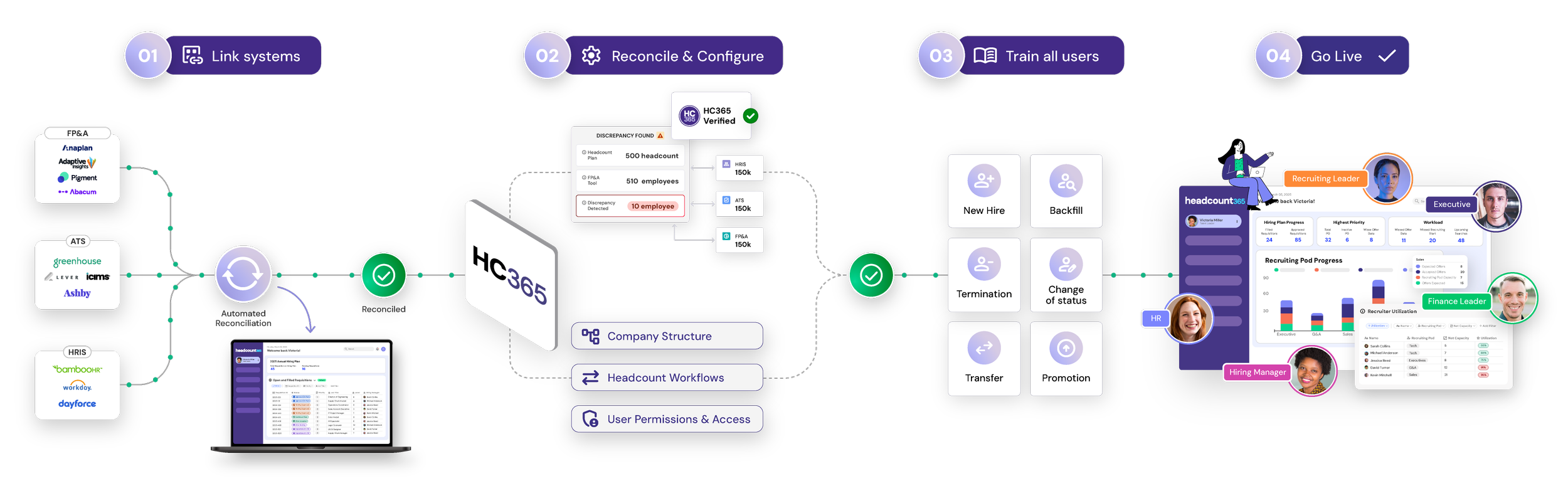
headcount365 implementations are led by headcount practitioners
Most enterprise software setups are transactional, handled by IT generalists who configure database fields without understanding your actual operational workflows. Headcount365 implementations are guided entirely by career headcount veterans.
Having scaled internal talent operations at hyper-growth organizations like Uber, Meta, Lyft, and AppNexus, and executed over 100 system implementations for premier investment portfolio companies like Insight Partners, we don’t just deploy software, we optimize your headcount operating model. We partner directly with your Finance, HR, and Recruiting leads to replace manual workarounds with institutional data standards from day one.
Systems Integrations & Data Alignment
The process begins by establishing secure connections across your existing headcount software stack. Your systems administrator can authorize connectivity within minutes, requiring zero internal engineering overhead.
Rapid API Authorization: Establish encrypted data sharing using industry standard authentication protocols.
Real Time Tracking: Actions taken inside your Applicant Tracking System or Human Resources Information System dynamically update the central ledger.
Ecosystem Interoperability: Headcount365 enables unified data streams across core enterprise platforms like Workday, Greenhouse, BambooHR, Lever, Ashby, Rippling, and Pigment to instantly mitigate cross departmental data drift.
Configuration and Taxonomy Standardization
With your core systems connected, we configure the platform to reflect your organization’s unique operational architecture, governance guardrails, and data definitions.
The Position as the Atomic Unit: Standardizing role bands, department codes, and cost center identifiers across disparate teams anchors every record to The Position as your core source of truth.
Automated Governance Guardrails: Programming your precise corporate governance and financial controls into custom approval chains ensures compensation adjustments or net new adds automatically route to the correct budget owners.
Role Based Access Control: Configuring strict permission matrices that dynamically restrict data visibility so users only see the specific parameters required for their functional role.
Training and Go Live Activation
With a validated database and configured workflows, we execute a seamless transition to the live environment, prioritizing immediate internal adoption and zero operational downtime.
Persona Dashboard Training: Conducting brief, tailored, 1 hour walkthroughs engineered explicitly for your distinct user groups, including Executive Leadership, Talent Acquisition, and Finance Business Partners.
System Activation: Launching live cross functional team access allows separate departments to execute their unique daily workflows while maintaining a unified real time ledger.
Dedicated Hyper Care Support: For the first two weeks post launch, our customer success team provides dedicated Hyper Care monitoring to instantly triage questions and ensure total operational continuity.
Rigorous Acceptance Testing
Before shifting your daily operations to the platform, we conduct deep validation to guarantee flawless data integrity and systems performance.
Settings Review and Validation: We review and validate approval workflow configurations, user permissions, and role verification scenarios.
End to End Workflow Validation: We verify that your ATS, HRIS, and Finance system data flows correctly to ensure complete data integrity.
Eradicating Historical Data Drift: Ingesting historical tracking files into our automated validation engine helps to identify and resolve hidden variances between top down financial budgets and active recruiting pipelines.
IMPLEMENTATION CASE STUDY
Read about Stepstone’s implementation experience with headcount365’s white glove implementation
“Headcount365’s full-service implementation condensed a complex enterprise rollout into a single 30-minute weekly meeting. With embedded consulting from experienced implementation leaders, we uncovered and fixed broken processes and data silos across Finance, HR, and Recruiting systems. The result: A fully integrated headcount data that finally works together.”

LINDA LAI
Vice President, HR Operations, Systems & Analytics
headcount365 Implementation FAQ
Timeline & Process
-
Every customer gets a 12-week implementation window with a dedicated Implementation Manager, but most complete implementation in four to six weeks. The pace is set almost entirely by how quickly prep work comes together. Whatever time is left in the 12-week window after go-live converts to hyper-care.
-
Seven phases: Prep Work (you gather required items before kickoff), Kickoff (instance provisioned, support channels live, plan aligned in a one-hour meeting), Configuration (systems linked, data reconciled, platform configured), Testing/UAT (every workflow proven end-to-end), Training (one hour per stakeholder group), Go-Live (launch announced on the date aligned at kickoff), and Hypercare (active support for the rest of the 12-week window).
-
Sometimes. The constraint is usually data cleanliness and stakeholder availability rather than our build time. Customers who arrive with SSO configured, a clean headcount plan, and unified emails across systems move fastest.
-
Three things, in order: SSO not being configured (nobody can log in), a headcount plan that needs reconciliation against the HRIS and ATS, and scheduling gaps when key stakeholders aren't available for working sessions.
-
It's fixed at kickoff, and everything else calculates backward from it. If a milestone slips, we rebase the intermediate dates rather than the launch date wherever possible.
Prep Work
-
Five items: pre-configure SSO, upload your current headcount plan, export your departments and cost centers from your HRIS/ATS/FP&A tool, gather your ATS integration documentation, and schedule the 60-minute kickoff. These block the timeline if missing
-
That's completely fine — we'll build it with you. Whether it's a leveling framework, a standardized job title list, or a clean headcount plan, your Implementation Manager has templates and dedicated working sessions for exactly this. A missing item is a conversation, not a blocker.
-
Accelerators: unique headcount IDs, cleaned-up ATS job templates, recruiting team configuration, a standardized job title list, your leveling framework, confirming ATS user emails match the HRIS, exporting custom fields, and drafting your approval workflows. None gate the timeline, but each one removes a working session later.
Team & Communication
-
Three people: an Account Manager (commercial continuity from sales), an Implementation Manager / CSM (your day-to-day owner, runs configuration and the project plan), and Solutions/Engineering (backend configuration and integration support).
-
An executive sponsor, a project lead or admin who owns day-to-day decisions and prep work, a recruiting lead, a finance lead, and someone from IT for SSO and integrations. Recruiting and finance also participate in testing.
-
A shared Slack channel opened at kickoff for day-to-day questions, plus recurring weekly syncs. Every question and decision is logged in an Open Questions tracker with a named owner, which doubles as the record of why things were configured the way they were.
-
A weekly status email drawn from the Executive Summary: overall health, phase progress, blockers, and what's needed to stay on track. Everyone from the sales and implementation process is included by default and can opt out.
Systems & Integrations
-
Your ATS, your HRIS, and your FP&A tool. Integrations are built during the Configuration phase, typically one to two days of connection work per system.
-
Either API or SFTP. You choose at kickoff. We supervise the first upload together, import employee records, and map department, location, and custom fields.
-
Guided setup through an in-app wizard with your CSM. It covers the API key and webhooks, user role mapping, close-reason mapping, and field mapping for openings, candidates, and offers. Once live, requisitions push from headcount365 into your ATS and offer status flows back automatically.
-
Yes. SSO is how users access the application, and configuring it early speeds up everything downstream. We support Okta OIDC and SAML, and provide setup guides for both.
-
No. The business email in your HRIS is the source of truth for user access. When the same person has different addresses in the ATS and HRIS, logins break and reconciliation between hired candidates and new employees fails. A quick self-audit before kickoff avoids both.
Configuration
-
Systems linked, data reconciled (plan year configured, department and cost center owners assigned, fields unified), then platform configuration: users and roles, field-level permissions, job titles, talent team structure, request forms for new hires and backfills, the reconciliation form, and your approval workflows.
-
One to two weeks typically. Linking systems is one to two days, data reconciliation one to three days, and platform configuration five to fifteen days depending on data cleanliness, how much customization you need, and stakeholder responsiveness.
-
You define them, we configure them. Each workflow gets a name, the request types it applies to (new hires and backfills, modifications, or both), trigger criteria such as department or business unit, and approvers in order — up to five steps. There's a default workflow if you want to start simple.
-
Yes, and it's worth discussing at kickoff. We'll explicitly ask which processes to move over as-is and which are worth upgrading while everything is already open.
Testing, Training & Launch
-
Every workflow end-to-end before anyone is trained: form field validation, new hire and backfill approvals, modifications with and without approvals, all three ATS push methods, the full offer lifecycle from pending through accepted to filled, field sync across ATS/HC365/HRIS, and permissions for fields, reports, and dashboards. You can add custom scenarios.
-
One-hour sessions by group: super admins and admins (train-the-trainer), recruiting leaders, the finance team, and HR managers/HRBPs. Admins are trained first so you have internal expertise from day one.
-
IT enables SSO login for all users, you send go-live communications to the company, and we enable email notifications in the platform.
After Go-Live
-
Whatever remains of your 12-week window after launch — finish in eight weeks and you get four weeks of hypercare. Your Slack channel stays open and your Implementation Manager, the support team, and your Account Manager are all active, triaging issues quickly and making sure adoption sticks
-
You transition to standard support with recurring success syncs. You also meet the ongoing support and account management team before the handoff, so it's an introduction rather than a cold transfer.
-
Yes. A structured review covering support quality, effort required, and overall ease.

SINGLE SOURCE OF TRUTH
Best Practices Included
Implementation quality is at the core of headcount365. Put simply, this is the tool that our founders wished they had when they were operating global talent teams.
By combining hiring data, existing employee data, and financial context into one, cohesive story, leadership can be more strategic than ever in regard to headcount planning. This helps companies move fast, decide accurately, and communicate clearly across functions.