
Table of Contents
AI’s Negligible Impact on Recruiting Capacity
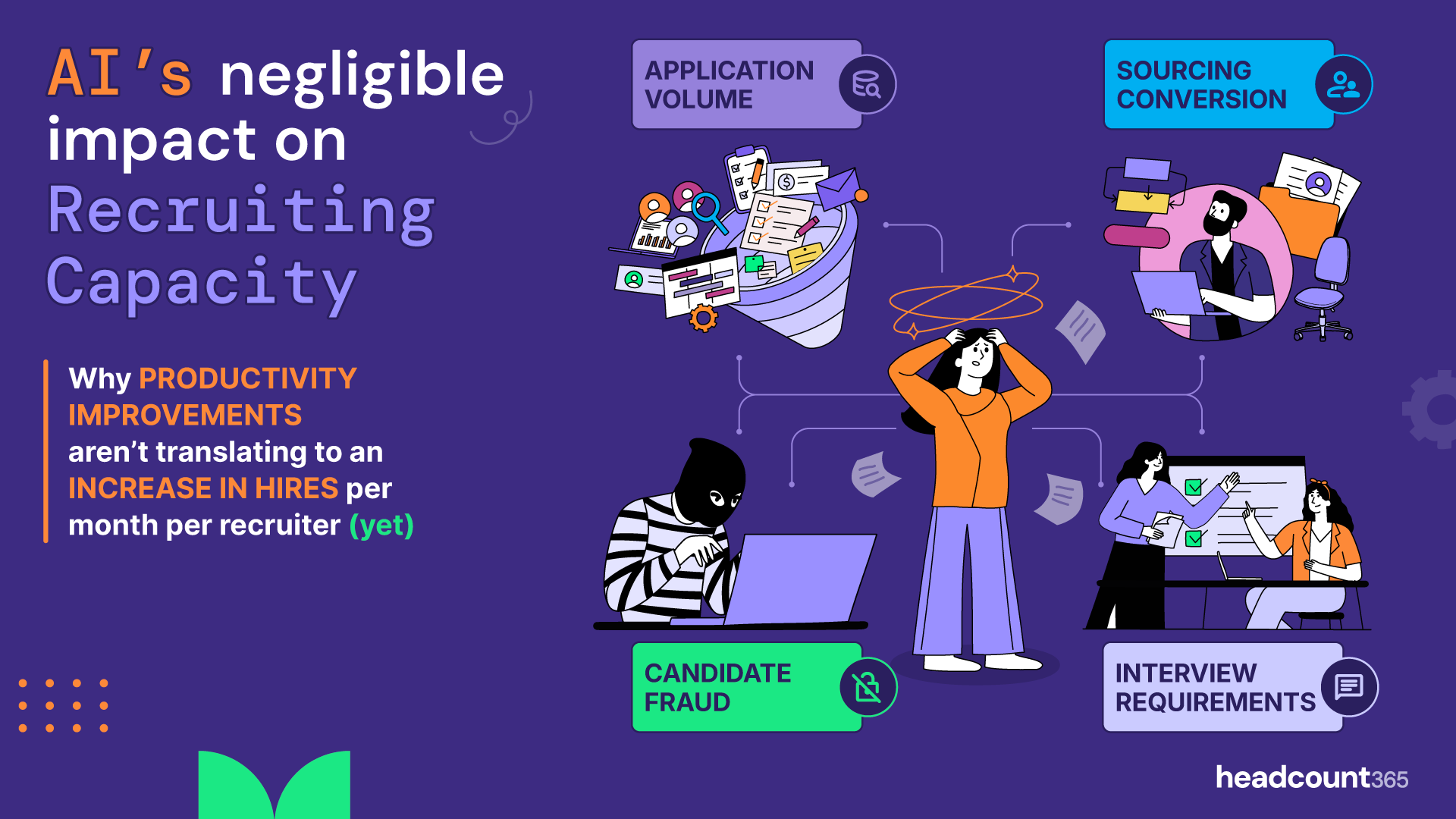
The Core Challenge: Why productivity improvements aren’t translating to an increase in hires per month per recruiter (yet).
| Friction Point | Impact on Recruiter Capacity |
|---|---|
| Application Volume | The sheer volume of incoming applications (often AI-generated) increases the noise-to-signal ratio, requiring more filtering time. |
| Sourcing Conversion | While sourcing is faster, converting those leads into active candidates remains a manual, time-intensive bottleneck. |
| Candidate Fraud | The rise of AI-assisted cheating or fake profiles necessitates more rigorous and manual verification steps. |
| Interview Requirements | Increasingly complex interview loops and evaluation standards offset the time saved by automated scheduling. |
Source: headcount365
AI’s real impact on individual recruiter capacity
The promise of AI in the recruiting stack was a massive unlock of latent productivity. On paper, it was the ultimate force multiplier: candidates would find their ideal roles through semantic matching, recruiters would automate the logistical "grunt work" of scheduling and feedback consolidation, and hires per month would scale linearly with the technology.
However, we are observing a distinct Efficiency Paradox. While specialized organizations, (Recruiting teams large enough to fragment the funnel into discrete units like sourcing, coordination, and closing, can often insulate their mid-funnel recruiters from this noise by restructuring workflows, the "full-cycle" recruiter enjoys no such luxury. For the generalist, AI has not merely automated tasks; it has fundamentally degraded the environment in which they operate. The productivity gains leaders expect are being cannibalized by an "AI Tax" of increased volume, candidate fraud, and sinking response rates.
This article examines why the traditional full-cycle workflow is being invalidated and why, counterintuitively, the more "productive" your tools become, the more your actual hiring capacity may be staying flat.
Four ways AI has changed recruiting capacity
1. Skyrocketing Top-of-Funnel (ToF) Volume
The democratization of generative AI has effectively lowered the "cost of entry" to most hiring pipelines for candidates to zero, resulting in a catastrophic surge of hyper-tailored applications that lack authentic alignment. This volume forces recruiting teams to move from a proactive talent-matching model to a defensive "batch-processing" stance, where the sheer labor of clearing the queue cannibalizes the time required for high-signal assessment.
This has led to:
Application Windows: Teams (like those at Ashby) are being forced to close applications after short bursts just to keep up. Listen to Jim Miller talk about this concept on the headcount experts podcast (Headcount Experts Episode 5- Jim Miller)
Sequential Batching: Recruiters are processing "rounds" of candidates chronologically rather than holistically, simply because the volume is too high to manage at once.
The Capacity Drain: Every extra hour spent screening "AI-optimized" resumes is an hour taken away from high-touch sourcing or closing top talent.
2. The Rise of Candidate Fraud
Candidate fraud is a spectrum of misrepresentation. Ranging from "resume padding" of overstated skills or inflated to high-fidelity cheating on technical assessments all the way up to the wholesale fabrication of identity.
Legacy vetting protocols, and the capacity models built upon them, were designed for an era where a candidate’s physical and vocal identity was a fixed constant. We operated on the assumption that you could not effortlessly mask your face, synthesize your voice, or leverage real-time LLMs to ghostwrite answers during a live interview.
“Fraudulent applicants can be more than 55% of the applicants in a single pipeline, all with profiles that are hyper-tailored to the role. Unchecked Fraud adds thousands of hours of manual work and hundreds of interviews to recruiting team calendars per year. ”
Use ToFu’s Fraud calculator to see how your company may be impacted
As these physical and intellectual barriers dissolve, the "trust tax" on recruiters has surged, requiring a level of manual verification that effectively resets the clock on every "automated" efficiency gained elsewhere in the funnel.
Detection Lag: If fraud is caught in the final round, the recruiter has wasted weeks of capacity on a "ghost."
Vetting Tax: Recruiters now have to spend more time "proving" a candidate is who they say they are, adding a layer of skepticism and administrative work to the early stages.
3. Outreach Effectiveness is Waning
The saturation of "hyper-personalized" outbound messaging has triggered a defensive response from high-quality talent, who now treat automated outreach as digital noise rather than professional opportunity. As response rates plummet, recruiters are forced to double their outbound activity simply to maintain a static pipeline, creating a treadmill effect where increased effort yields diminishing returns.
The Noise Floor: Candidates are overwhelmed, leading to plummeting response rates.
Increased Effort: Recruiters now have to work twice as hard (and send twice as many messages) to get the same number of initial screens as they did two years ago.
4. AI is Reshaping Mid-Funnel Efficiency
The erosion of trust in digital artifacts, from the resume to the take-home exercise, is forcing a return to resource-heavy, synchronous testing and in-person requirements. This "Verification Tax" creates a logistical drag on the mid-funnel, as teams must now invest significant human hours into proctoring and unified debriefs just to reclaim the baseline certainty that previously existed by default.
In-Person Safeguards: To combat AI-assisted cheating and fraud, companies are reverting to in-person interviews or proctored assessments, which are significantly harder to coordinate.
Assessment Decay: Standard take-home assignments are losing effectiveness as AI can solve them in seconds. This requires more human-centric, synchronous testing.
Debrief Complexity: While AI notes are great, they lack nuance. Teams are finding they need more meeting time—not less—to provide context and unified decision-making around AI-generated summaries.
What This Means for Your Recruiting Capacity
We are currently navigating a volatile period of transition where the "norms" of the AI-augmented recruiting cycle are still being determined. While AI was intended to reduce human effort, the reality is a shift rather than a reduction. This shift represents a compensatory human effort designed to absorb the environmental volatility, specifically volume and fraud that AI has introduced.
As recruiters strive to maintain the mid-funnel conversion rates that organizations have historically come to expect, recruiting teams must now act as an intensified filtration layer. This serves a critical protective function: by absorbing the labor-intensive task of identifying high-fidelity misrepresentation and clearing digital noise, recruiters ensure that hiring managers are shielded from the "Tax." The goal is to preserve the manager's ability to make final hiring decisions based on high-signal data, even as the cost of producing that data increases.
Ultimately, this means that for the foreseeable future, recruiting capacity will remain suppressed. Until the market establishes new standards for verification and volume management, organizations must recognize that their "automated" funnel requires more human oversight than ever before to maintain its integrity.
Simply stated:
More noise = less hiring volume for the same level of quality.
Recruiting Capacity Planning in the Age of AI
If your workforce plan assumes that AI will allow your recruiters to double their hiring output, you are likely heading for a miss. To maintain your current hiring velocity, you must adjust your workforce plan and budget to account for the additional human effort required to navigate an AI-saturated landscape.
In the age of AI, the human recruiter hasn't become less important, they’ve become the most expensive and necessary filter in the process.
Track Recruiting Capacity vs Demand over time with Headcount365
headcount365 is the only workforce planning tool with comprehensive recruiting capacity vs demand history to help recruiting leaders track actual offer accepts per month as a relationship to expected offer.