
AI created the Finance Engineer.
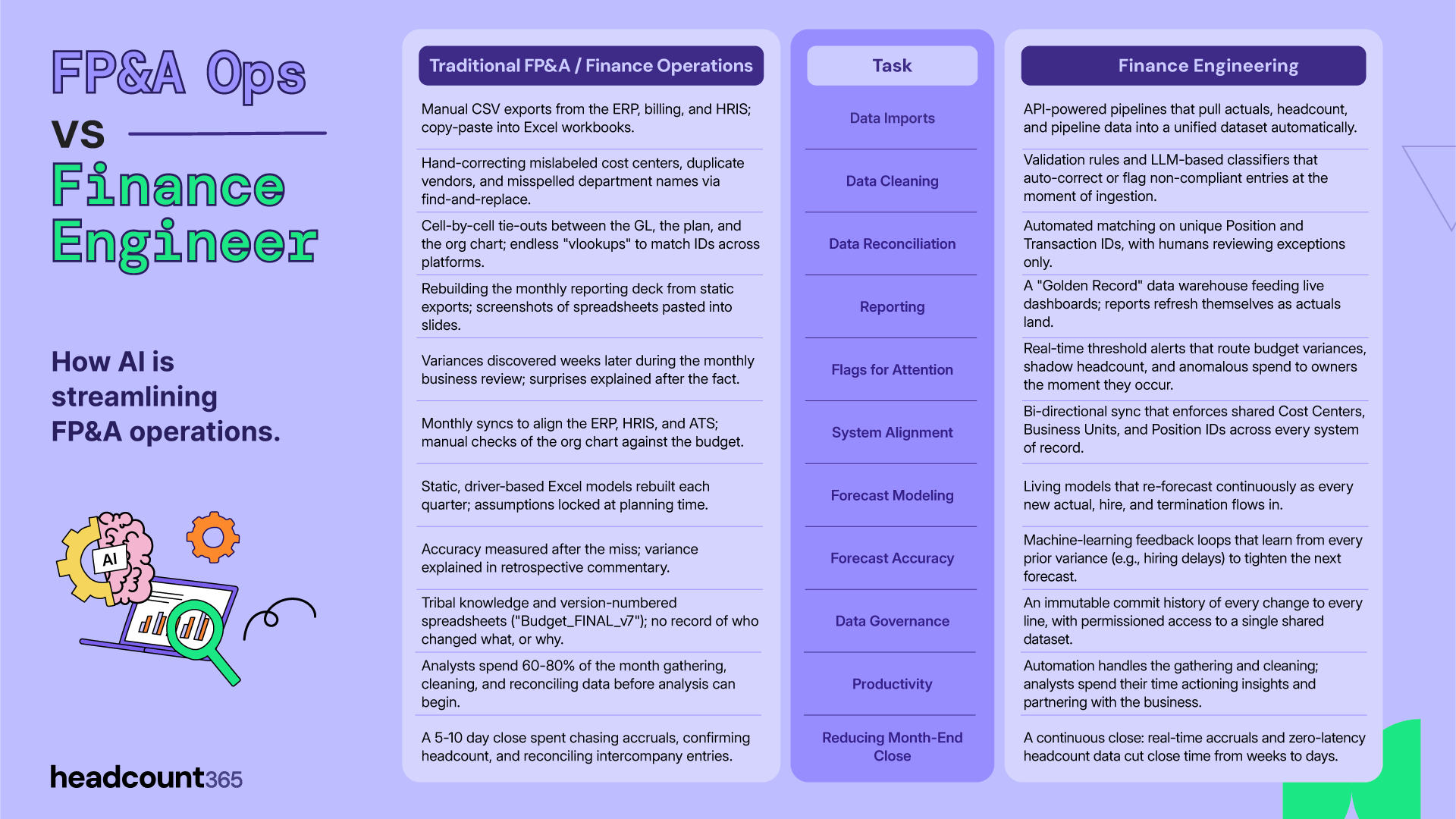
| Task | Traditional FP&A / Finance Operations | Finance Engineering |
|---|---|---|
| Data Imports | Manual CSV exports from the ERP, billing, and HRIS; copy-paste into Excel workbooks. | API-powered pipelines that pull actuals, headcount, and pipeline data into a unified dataset automatically. |
| Data Cleaning | Hand-correcting mislabeled cost centers, duplicate vendors, and misspelled department names via find-and-replace. | Validation rules and LLM-based classifiers that auto-correct or flag non-compliant entries at the moment of ingestion. |
| Data Reconciliation | Cell-by-cell tie-outs between the GL, the plan, and the org chart; endless "vlookups" to match IDs across platforms. | Automated matching on unique Position and Transaction IDs, with humans reviewing exceptions only. |
| Reporting | Rebuilding the monthly reporting deck from static exports; screenshots of spreadsheets pasted into slides. | A "Golden Record" data warehouse feeding live dashboards; reports refresh themselves as actuals land. |
| Flags for Attention | Variances discovered weeks later during the monthly business review; surprises explained after the fact. | Real-time threshold alerts that route budget variances, shadow headcount, and anomalous spend to owners the moment they occur. |
| System Alignment | Monthly syncs to align the ERP, HRIS, and ATS; manual checks of the org chart against the budget. | Bi-directional sync that enforces shared Cost Centers, Business Units, and Position IDs across every system of record. |
| Forecast Modeling | Static, driver-based Excel models rebuilt each quarter; assumptions locked at planning time. | Living models that re-forecast continuously as every new actual, hire, and termination flows in. |
| Forecast Accuracy | Accuracy measured after the miss; variance explained in retrospective commentary. | Machine-learning feedback loops that learn from every prior variance (e.g., hiring delays) to tighten the next forecast. |
| Data Governance | Tribal knowledge and version-numbered spreadsheets ("Budget_FINAL_v7"); no record of who changed what, or why. | An immutable commit history of every change to every line, with permissioned access to a single shared dataset. |
| Productivity | Analysts spend 60-80% of the month gathering, cleaning, and reconciling data before analysis can begin. | Automation handles the gathering and cleaning; analysts spend their time actioning insights and partnering with the business. |
| Reducing Month-End Close | A 5-10 day close spent chasing accruals, confirming headcount, and reconciling intercompany entries. | A continuous close: real-time accruals and zero-latency headcount data cut close time from weeks to days. |
Table of Contents
What is a Finance Engineer, and how is it different from traditional finance roles?
FP&A benefited from AI faster than most functions for an uncomfortable reason: an enormous share of the work was never analysis in the first place. It was data managemnet. Analysts spent the bulk of every month gathering data from the ERP, the billing system, and the HRIS, cleaning mislabeled cost centers and duplicate vendors, and reconciling IDs across platforms with an endless chain of VLOOKUPs. By the time the numbers were trustworthy, the month was nearly over and the story was retrospective.
AI moved FP&A towards action
Before AI, great FP&A leaders both created great data process & structure AND applied this data to scenarios that help the business make better decisions. With AI, the focus is much more about applied FP&A than process, creating a role for the Finance Engineer to exist. They enable FP&A to do their role more effectively.
Automation Leveled the Playing Field
API-powered pipelines pull sales data, headcount, and other key data into a unified dataset without spreadsheet cleanup or manual reconciliation These reconciliations run on algorithms, trimming processes that used to take days or weeks into a single button click. For most, individual tasks got faster, but for some, the entire prep phase stopped being a human job.
Ease of Experimentation
Once data flows continuously and models run on live inputs, the marginal cost of asking "what if" drops toward zero. Static models rebuilt each quarter are now living forecasts that update continuously. That shift turns forecasting from a periodic ritual into an ongoing experiment. Finance stops producing one answer a quarter and starts producing a continuously updated distribution of answers.
Finance engineers need a systems mindset
Automations don't build or maintain themselves. Someone has to own the pipelines, the shared data model, the governance, and the enforcement of common IDs across every system of record. That ownership doesn't fit the traditional analyst's job description, and it doesn't quite fit central IT or data engineering either those teams have the build skills but not the finance context.
The gap between "analyst who can't maintain infrastructure" and "engineer who doesn't understand a model" is exactly where the Finance Engineer stands.The clearest way to understand the Finance Engineer is through the mental model each role brings to the work.
Before AI, data had to be fetched and assembled each cycle. The reporting deck gets rebuilt each month; the model gets rebuilt each quarter. The work is artisanal: every analysis is a bespoke artifact, crafted by hand and difficult to reproduce.
Finance Engineering moves process into systems. The unit of work is the pipeline, the data warehouse, and the living model. The Finance Engineer manages infrastructure that you build once and maintain, not a deliverable you recreate. The work is industrial: repeatable, governed, and version-controlled, with an immutable history of who changed what and why.
4 Problems created from the Finance Engineer Role
With all of the efficiency, and systems focus the The Finance Engineer role introduces a fresh set of problems that traditional FP&A never had to manage.
Data Validation Hallucinations fill the gaps in bad data. An AI system is only as good as the data underneath. Confident, plausible-but-wrong linkage is far more dangerous than an obvious error, because nothing about it looks off. A human analyst usually knew where the data was thin and left the cell blank; an LLM fills the void without telling you it did. That makes validating the underlying data model, and the prompt/ context structure that feed it a new, permanent job. The Finance Engineer has to guarantee the inputs before anyone can trust a single output.
QA Work: Risk and error scale with automation, as it multiplies throughput, and the error along with it. One bad rule, one mislabeled field, or one silently broken pipeline no longer produces a just one wrong cell. This can impact whole models and forecasts. In manual FP&A, humans touched each number. FP&A engineering requires a QA discipline test coverage on pipelines, reconciliation checks, exception review — that simply wasn't a job when the work was done by hand.
Output Validation & the "good enough" trap: AI outputs fail in two ways. 1) Complacency: when an automated number looks reasonable, there's a real temptation to accept it without a check. Automation lowers the friction of producing an answer, which quietly lowers the bar for scrutinizing it. 2) Investigations are harder. In a spreadsheet you could trace a figure back through visible cells; in a chain of joins, classifiers, and models, root-causing an anomaly means digging through layers of automated logic.
Data Security: When that data lives in siloed spreadsheets owned by different people, access is fragmented The moment you consolidate everything into AI tools, that accidental firewall disappears and you've created a single, high-value target. Someone now has to deliberately design and enforce permissions: who sees what, which fields flow into which model, and what never leaves finance at all. That governance is a genuinely new obligation, and it lands squarely on the Finance Engineer.
headcount365 is the data layer built for Finance Engineers
Headcount is the the largest, most complex cost center with payroll, comp, and org data being among the most sensitive information. Headcount is also the hardest data to reconcile: it changes constantly, and those changes originate across multiple systems and multiple owners. Recruiting in the ATS, HR in the HRIS, finance in the plan, each updating on its own cadence.
Without headcount365, the headcount dataset breaks the Finance Engineer's data pipeline.
Every way headcount365 helps the Finance Engineer
Data validation: An authoritative, structured record of every hire, start date, and termination leaves the AI zero gaps to hallucinate across. The model builds on verified inputs instead of inventing connections to fill the holes.
QA work: The headcount feed arrives already reconciled on consistent, Unified Headcount IDs, so it's one less place for a silent error to propagate through every downstream forecast.
Output validation: Every headcount gets an auditable history, with changes tracked across all users and systems, so when a figure looks off you can trace it back instantly with an AI summary of the activity to help diagnose.
Data security: headcount365 exposes only the fields finance needs and controls exactly what flows into which model, so sensitive comp and org data never leaks into places it shouldn't.
System alignment: Because it enforces unified headcount IDs across the ATS, HRIS, and ERP, headcount365 keeps the org chart, the budget we eliminate the reconciliation drift that used to consume the monthly close.
Continuous forecasting: Start dates, ramp, and attrition flow into the model the moment they change, so the living forecast reflects reality in real time rather than assumptions locked at planning day.
headcount365 is the best tool in the finance engineer’s tech stack
Every CFO wants the same thing. The ability to speak about the financial performance of the company to the rest of the business with confidence. Whether its reporting on what happened, or helping scenario plan the future, they want credibility. The Finance Engineer produces the method, and headcount365 produces the data for the largest variable.
CFO benefits from headcount365 in the finance engineer tech stack
Predictable, headcount-driven spend and revenue Newly hired employees change the P&L on their start date, adding cost immediately add revenue only once they ramp. Knowing when someone starts and how long they take to reach full productivity is the difference between a forecast that holds and one that drifts. headcount365 gives every Finance Engineer a predictable start date for every open role, using a start-date algorithm that accounts for ATS status, recruiter capacity, and historic conversion rates — so both expense timing and capacity plans are built on real dates, not planning-day guesses.
Predictable attrition When people leave, both cost and capacity leave with them, and the variance usually surfaces in finance's numbers weeks later. Predicting attrition and hiring ahead of it shrinks that gap. (We wrote a full breakdown here: How to Calculate the Cost Impact of Headcount Turnover on Sales and Revenue.) Feeding predicted attrition into a living model is exactly the kind of feedback loop that tightens the next forecast instead of explaining the last one.
Always-accurate headcount data in your AI model of choice Before headcount365, headcount reached the budget through a spreadsheet tracker hand-updated by recruiting, the HRBP, and finance. This is because giving finance full system access exposed far more employee data than it needed. headcount365 exposes only the headcount data finance's models require, as a governed, permissioned single source of truth with consistent Position IDs across your ERP, HRIS, and ATS.
Whether you’re a finance engineer building a data pipeline, or an FP&A leader looking to incorporate headcount data into your AI model, headcount365 has options that fit every business