
AI in the Org Chart: Siloed AI Employees or Centralized AI Tools Teams?
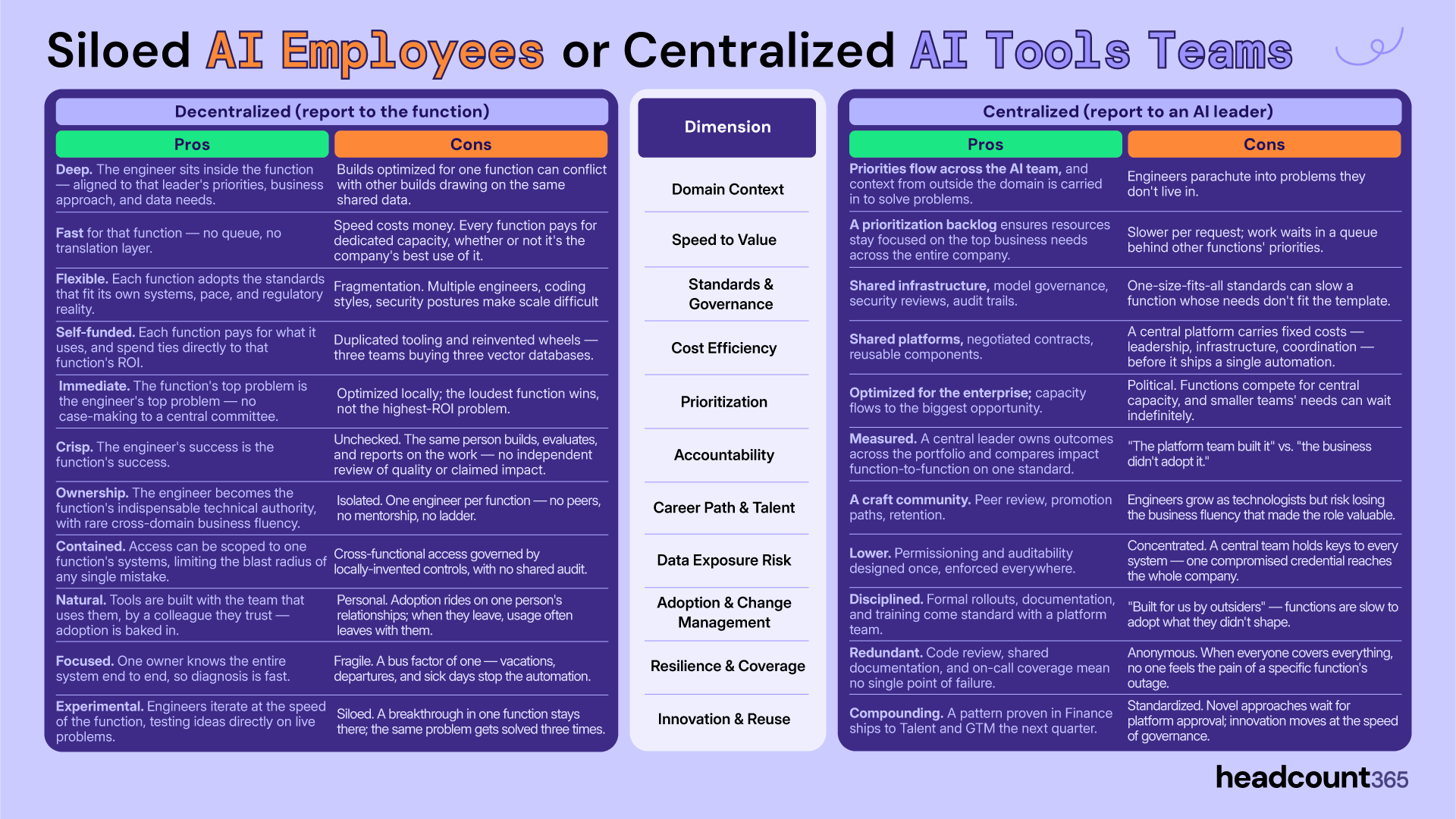
| Dimension | Decentralized Pros | Decentralized Cons | Centralized Pros | Centralized Cons |
|---|---|---|---|---|
| Domain Context | Deep. The engineer sits inside the function — aligned to that leader's priorities, business approach, and data needs. | Builds optimized for one function can conflict with other builds drawing on the same shared data. | Priorities flow across the AI team, and context from outside the domain is carried in to solve problems. | Engineers parachute into problems they don't live in. |
| Speed to Value | Fast for that function — no queue, no translation layer. | Speed costs money. Every function pays for dedicated capacity, whether or not it's the company's best use of it. | A prioritization backlog ensures resources stay focused on the top business needs across the entire company. | Slower per request; work waits in a queue behind other functions' priorities. |
| Standards & Governance | Flexible. Each function adopts the standards that fit its own systems, pace, and regulatory reality. | Fragmentation. Multiple engineers, coding styles, security postures make scale difficult. | Shared infrastructure, model governance, security reviews, audit trails. | One-size-fits-all standards can slow a function whose needs don't fit the template. |
| Cost Efficiency | Self-funded. Each function pays for what it uses, and spend ties directly to that function's ROI. | Duplicated tooling and reinvented wheels — three teams buying three vector databases. | Shared platforms, negotiated contracts, reusable components. | A central platform carries fixed costs — leadership, infrastructure, coordination — before it ships a single automation. |
| Prioritization | Immediate. The function's top problem is the engineer's top problem — no case-making to a central committee. | Optimized locally; the loudest function wins, not the highest-ROI problem. | Optimized for the enterprise; capacity flows to the biggest opportunity. | Political. Functions compete for central capacity, and smaller teams' needs can wait indefinitely. |
| Accountability | Crisp. The engineer's success is the function's success. | Unchecked. The same person builds, evaluates, and reports on the work — no independent review of quality or claimed impact. | Measured. A central leader owns outcomes across the portfolio and compares impact function-to-function on one standard. | "The platform team built it" vs. "the business didn't adopt it." |
| Career Path & Talent | Ownership. The engineer becomes the function's indispensable technical authority, with rare cross-domain business fluency. | Isolated. One engineer per function — no peers, no mentorship, no ladder. | A craft community. Peer review, promotion paths, retention. | Engineers grow as technologists but risk losing the business fluency that made the role valuable. |
| Data Exposure Risk | Contained. Access can be scoped to one function's systems, limiting the blast radius of any single mistake. | Cross-functional access governed by locally-invented controls, with no shared audit. | Lower. Permissioning and auditability designed once, enforced everywhere. | Concentrated. A central team holds keys to every system — one compromised credential reaches the whole company. |
| Adoption & Change Management | Natural. Tools are built with the team that uses them, by a colleague they trust — adoption is baked in. | Personal. Adoption rides on one person's relationships; when they leave, usage often leaves with them. | Disciplined. Formal rollouts, documentation, and training come standard with a platform team. | "Built for us by outsiders" — functions are slow to adopt what they didn't shape. |
| Resilience & Coverage | Focused. One owner knows the entire system end to end, so diagnosis is fast. | Fragile. A bus factor of one — vacations, departures, and sick days stop the automation. | Redundant. Code review, shared documentation, and on-call coverage mean no single point of failure. | Anonymous. When everyone covers everything, no one feels the pain of a specific function's outage. |
| Innovation & Reuse | Experimental. Engineers iterate at the speed of the function, testing ideas directly on live problems. | Siloed. A breakthrough in one function stays there; the same problem gets solved three times. | Compounding. A pattern proven in Finance ships to Talent and GTM the next quarter. | Standardized. Novel approaches wait for platform approval; innovation moves at the speed of governance. |
Table of Contents
AI is creating new roles for individual teams, transforming operations & enablement roles into product-creating engineers who operate at the system level. The debate we’re looking at today? Should that engineer report to a line manager or a centralized AI team?
Embedded AI Engineers or AI CoE (Center of Excellence)
Decentralized teams have each engineer reporting to their function. The Talent Engineer reports to the CHRO, the GTM Engineer to the CRO, the Finance Engineer to the CFO. Centralized AI means all engineers report to a single AI or automation leader. This could be something like a Head of AI enablement, who is responsible for deploying AI workflows & the capacity of those who create it across the org.
Centralized teams: Pros & Cons
Pros
Standardization and governance: Single definitions of key metrics, strict security protocols, and uniform tech stacks.
Cost efficiency: Eliminates duplicate software licenses and gives the company leverage for vendor negotiations.
Talent management: Easier to recruit specialists, maintain high technical standards, and manage career progression under domain-expert managers.
Cons:
Ticket queues and latency: Business units get stuck in long request backlogs, slowing down execution.
Context loss: Centralized specialists don't understand the daily operational nuances of specific business units.
Rogue workarounds: Slow turnaround times drive business units to hire shadow teams or swipe credit cards for unauthorized tools.
Decentralized/Embedded AI Teams
Pros:
Speed and agility: Local teams deploy solutions immediately without waiting for central sign-offs or queue approvals.
Deep domain context: Engineers and analysts work directly alongside business owners, building tools tailored to specific problems.
Local ownership: Business unit leaders control their own priorities, resources, and execution timelines.
Cons:
Fragmented truth and duplicate effort: Different departments end up building the same tools or relying on conflicting data.
Security and compliance risks: Siloed teams frequently bypass central security audits, procurement rules, and legal reviews.
Cognitive overload: Local teams waste time reinventing foundational infrastructure rather than focusing on business logic.
When should I centralize my AI team?
AI Initiatives vs AI strategy
Your first AI engineer should almost always be decentralized. At this stage, the constraint is context, not governance. The Finance Engineer who reports to the CFO ships a continuous-close pipeline in a quarter because they sit inside the problem. A central "AI team of one" reporting to no function tends to produce demos, not production systems.
Scaling Initiatives past 1-2 functions or when teams are competing over limited resources
Hiring two or three of these engineers, with different leaders competing for capacity, adds stress to the system. Individuals using the same dataset may now modify something another engineer needs. Duplicated tooling, incompatible data models, uneven security require a thin central layer. Shared infrastructure, a baseline governance standard, and a common data foundation help reduce friction between siloed engineers who keep reporting to their functions. Think hub-and-spoke: the hub owns how things are built; the spokes own what gets built.
Fully embedded AI, backed by a company strategy
At scale, a centralized AI leader owns the platform and the security posture deploying engineers into functions with dotted-line accountability to the CHRO, CRO, and CFO. The functions keep their context and speed; the enterprise keeps its standards and leverage.
The org chart insight is this: the reporting line should follow the scarcest resource. Early on, that's context where embedded AI maximizes value. Later, it's governance and reuse where centralization shines.
Hidden Workload: AI Agent Maintenance
Here's where AI genuinely breaks the old playbook. In every prior version of this debate, the unit being allocated was a person. This allocation of people was often accompanied by a spreadsheet or a process the host team could maintain on their own. Now, under either model, the engineers are deploying AI agents, and agents are not headcount. They also require a specialized skillset to maintain as data sources, business processes, or company structure changes.
Traditional software breaks loudly with error codes or system crashes. AI agents break silently through model drift, prompt degradation, upstream schema shifts, or edge-case reasoning failures. When structuring your AI teams, maintenance can significantly impact the productivity of the teams. Some key considerations when deciding to centralize:
Rate of change. Automation loves stability. If the process, the systems, or the rules change every quarter, an agent becomes a maintenance liability. Productivity gains from automation are wasted re-engineering it. Fast-changing domains favor humans, who reconfigure themselves for free.
Complexity & edge cases. Agents excel at high-volume, well-bounded work with clean inputs: enrichment, reconciliation, scheduling, scorecard summarization. As the work gets more ambiguous, with more exceptions, more stakeholders, and more judgment, the automation surface shrinks and the case for headcount grows.
Context outside the data. This is the dimension leaders underweight. An agent can only reason over what it's fed. It doesn't know that the board just changed its risk appetite, that a candidate's reference gave a subtle warning, or that a "stalled" deal is actually waiting on a customer's fiscal year. Work that requires interpreting results with context outside the model's data needs a human in the loop, or a human, full stop.
Your AI strategy impacts your headcount plan
Ultimately, your choice of AI org structure directly dictates how you build your headcount plan. Forecasting team capacity is no longer a simple division of total workload by human output; it requires modeling the multiplier effect of deployed agents against specialized roles.
Centralizing AI engineering does not erase technical work inside business units. Centralized models create an even stronger justification for localized enablement roles. Business units still need embedded operators who understand local context enough to reconfigure workflows, debug prompt logic, and translate domain nuances back to the core platform team.
The financial upside of AI is only captured when a team can genuinely offload core tasks to an agent. If maintaining, monitoring, and patching an agent takes as many human hours as doing the manual work itself, you haven't optimized your headcount you’ve just shifted the labor from execution to babysitting.