
Build headcount management with AI, or buy headcount365?
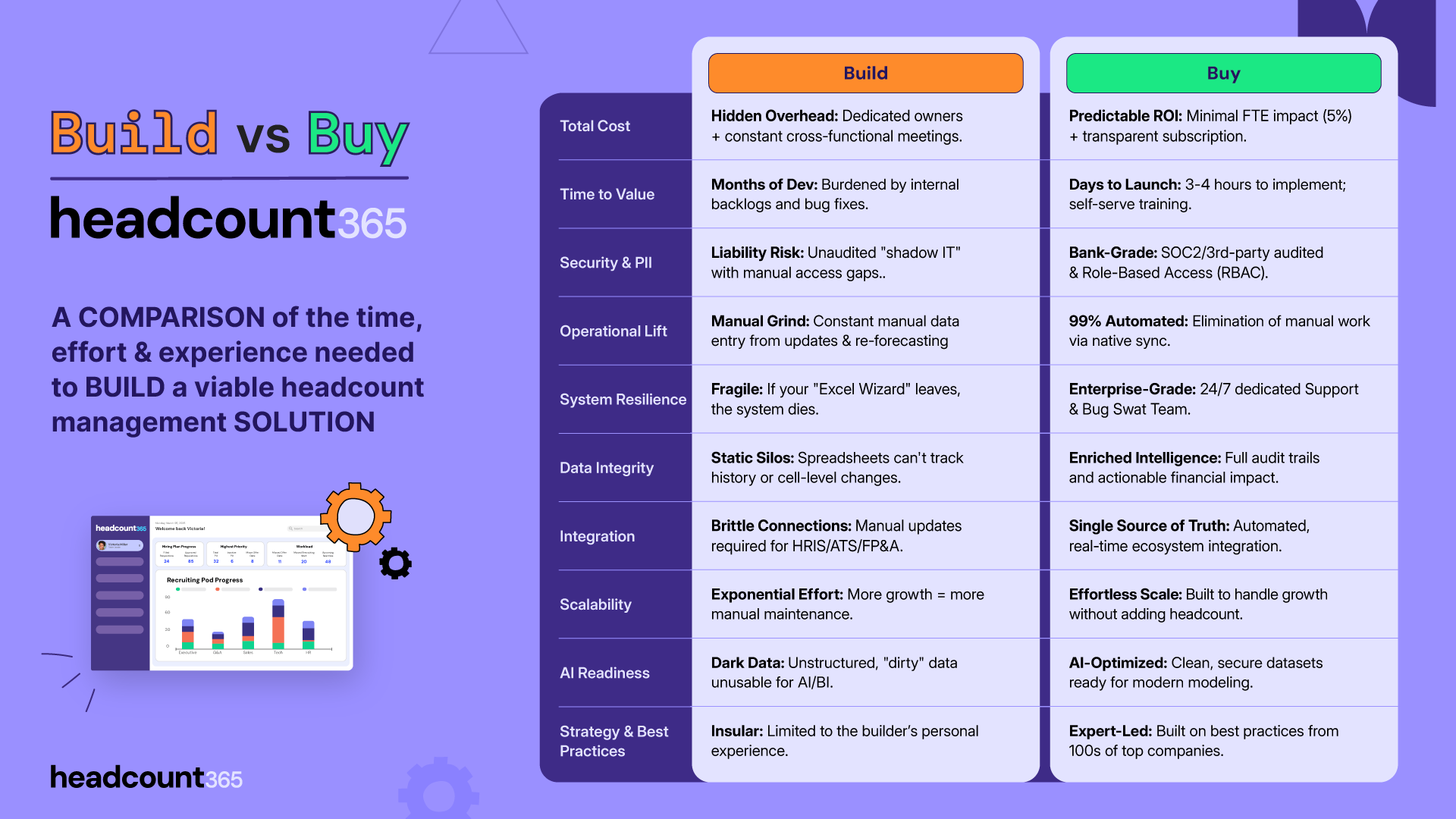
Table of Contents
| Strategic Driver | Build (Internal Development) | Buy (HC365 Solution) |
|---|---|---|
| Total Cost | Hidden Overhead: Dedicated owners + constant cross-functional meetings. | Predictable ROI: Minimal FTE impact (5%) + transparent subscription. |
| Time to Value | Months of Dev: Burdened by internal backlogs and bug fixes. | Days to Launch: 3-4 hours to implement; self-serve training. |
| Security & PII | Liability Risk: Unaudited "shadow IT" with manual access gaps. | Bank-Grade: SOC2/3rd-party audited & Role-Based Access (RBAC). |
| Operational Lift | Manual Grind: Constant manual data entry from updates & re-forecasting. | 99% Automated: Elimination of manual work via native sync. |
| System Resilience | Fragile: If your "Excel Wizard" leaves, the system dies. | Enterprise-Grade: 24/7 dedicated Support & Bug Swat Team. |
| Data Integrity | Static Silos: Spreadsheets can't track history or cell-level changes. | Enriched Intelligence: Full audit trails and actionable financial impact. |
| Integration | Brittle Connections: Manual updates required for HRIS/ATS/FP&A. | Single Source of Truth: Automated, real-time ecosystem integration. |
| Scalability | Exponential Effort: More growth = more manual maintenance. | Effortless Scale: Built to handle growth without adding headcount. |
| AI Readiness | Dark Data: Unstructured, "dirty" data unusable for AI/BI. | AI-Optimized: Clean, secure datasets ready for modern modeling. |
| Strategy & Best Practices | Insular: Limited to the builder's personal experience. | Expert-Led: Built on best practices from 100s of top companies. |
Considerations before building internal headcount management tools with AI
Vibe coding tools is easy, so what makes building a headcount management tool so hard? Hint: It’s not the code. It’s the process & data underneath. It’s the permissions and access for so many users. It’s the multi-system integration. It’s the maintenance of the systems through change.
5 Questions you should answer before building a headcount management tool with AI
Do I have a resource available to build and maintain this system?
Why it matters: Resource allocation determines the long-term viability of the tool; a system is only as good as the person available to maintain the quality of inputs.
The Build Risk: Internal builds require a dedicated owner and multiple cross-functional stakeholders. If the "Excel Wizard" or builder leaves the company, you face service interruptions and significant business risk because the tool is unsupported.
The Buy Efficiency: Implementation requires only 3–4 hours of customer time and a partial headcount. Maintenance, bug fixes, and feature development are handled by a dedicated "Bug Swat Team," ensuring the system functions regardless of internal staffing changes
Is our process consistent enough to be moved into an system?
Why it matters: Software cannot fix a broken process; consistency ensures that the data output is reliable for financial forecasting.
The Build Risk: In-house solutions rarely fix the underlying problem of misaligned department, cost center, and user taxonomy across different tools.
The Buy Efficiency: Using a specialized platform introduces a unified taxonomy across all systems, guided by an implementation manager who applies best practices derived from hundreds of companies. headcount365 has software solutions for mapping fields across systems that have proven results in keeping data clean
Is our data unified across all headcount systems (FP&A, HRIS, and ATS)?
Why it matters: Fragmented data leads to "manual grind," where teams spend more time reconciling numbers than analyzing them.
The Build Risk: Manual processes often result in "brittle connections" where changes in headcount require manual updates across HRIS, ATS, and FP&A to stay synced.
The Buy Efficiency: A purpose-built platform provides automated integration with these systems, creating a single source of truth and 99% elimination of manual work.
Is there a defined process for headcount changes?
Why it matters: Without a clear approval workflow, headcount growth becomes a "vibe coding" exercise that lacks financial rigor and security.
The Build Risk: Internal tools often use non-customizable approvals and manual tracking, which limits the intelligence regarding how an approval impacts the broader budget.
The Buy Efficiency: You gain access to a fully customizable approval engine designed to cover millions of use cases and specific customer requirements.
What permissions need to exist for each user?
Why it matters: Headcount data contains sensitive PII (Personally Identifiable Information); improper access controls create significant legal and insurance liabilities.
The Build Risk: Spreadsheets and "shadow IT" builds often lack secure-by-design development principles, meaning they may not qualify for insurance coverage in the event of a data breach.
The Buy Efficiency: The platform uses Role-Based Access Control (RBAC) to limit information at the browser level, backed by third-party audits and penetration testing to ensure bank-grade security.
The value of buying headcount365 over building an intenal headcount tool
Fast implementation with best practice advisory from headcount365’s team of ex-operators
A significant part of the value proposition for headcount365 is the embedded domain expertise. The platform was built by former practitioners from major organizations who have managed these processes internally for years.
When you build internally, your logic is limited to the personal experience of your specific builder. By contrast, using a dedicated platform provides access to a unified taxonomy across all tools, led by implementation managers who have seen hundreds of different configurations.
This advisory functions as a form of proprietary knowledge. It ensures that your department, cost center, and user fields are aligned across your HRIS, ATS, and FP&A tools. Instead of an internal owner being on call to fix a broken formula, you have a software bug swat team that maintains the system regardless of internal personnel changes.
headcount365’s proven data infrastructure creates clean data for every configuration
Headcount365 serves as a single source of truth by providing automated integration with end-user systems like HRIS, FP&A, and ATS. Unlike traditional spreadsheets that cannot track the history of an individual cell, this platform creates enriched data with full audit trails to improve a company's ability to make a meaningful financial impact. This infrastructure eliminates 99% of manual work and ensures a unified taxonomy across all systems. Because the data is cleaned and structured at the source, it moves beyond static silos into an AI-optimized dataset that is ready for modern modeling and BI tools.
Enterprise support, security, and scale in one package
The platform is built on secure-by-design development principles, utilizing role-based access control to limit sensitive information to authorized browsers. These protections are validated by third-party audits and penetration testing, offering bank-grade security that internal builds often lack. Beyond security, the system is designed for enterprise-grade resilience; a dedicated Software Bug Swat Team (SBST) manages maintenance and diagnostics, ensuring the system functions regardless of internal personnel changes or vacations. As an organization grows, headcount365 allows for effortless scale without requiring additional manual effort or increased internal headcount to maintain the system.