
The Talent Engineer: Integrating AI into Recruiting Operations & Enablement
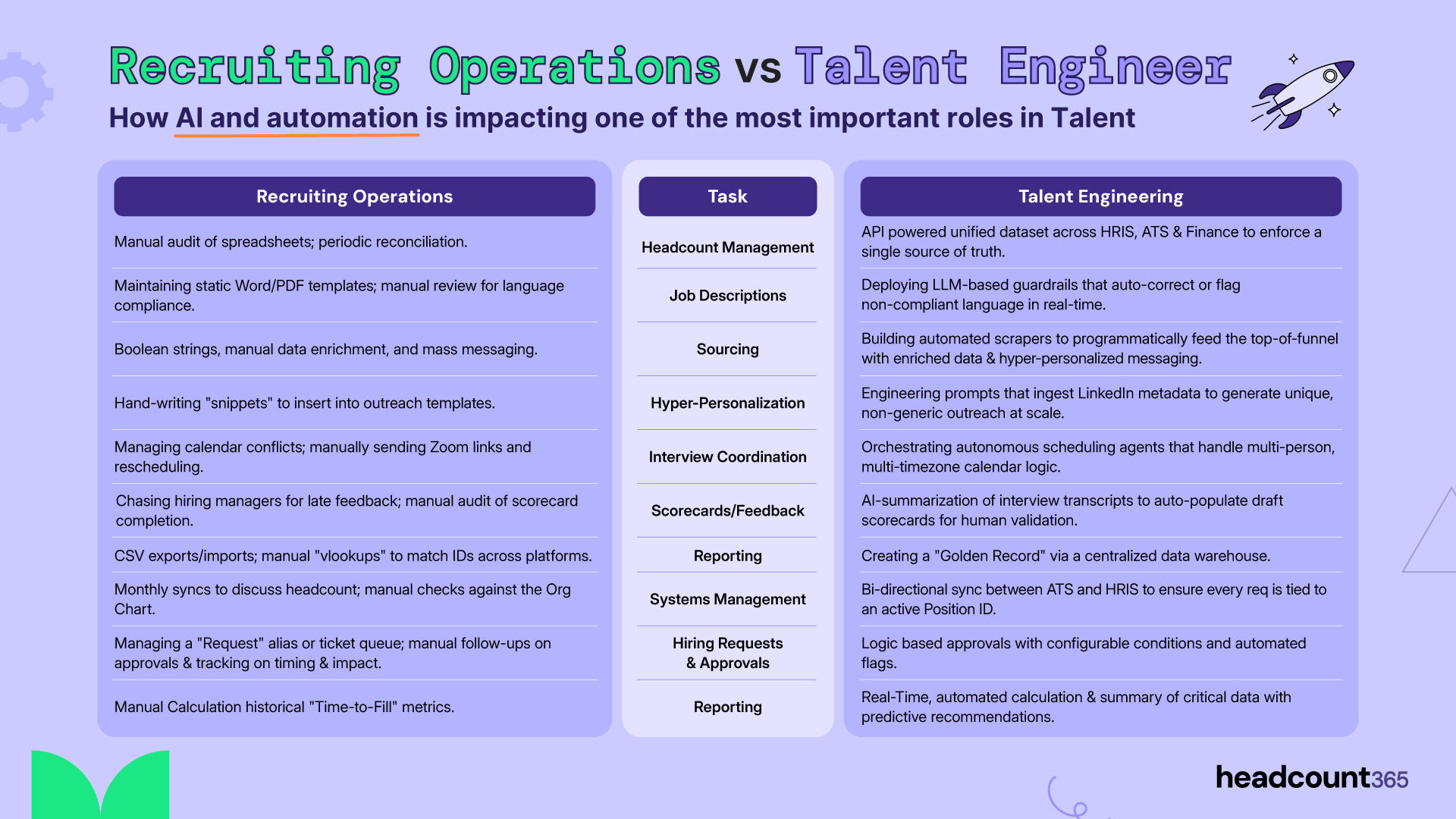
Table of Contents
| Task Category | Recruiting Operations (Manual) | Talent Engineering (AI & Automation) |
|---|---|---|
| Headcount Management | Manual audit of spreadsheets; periodic reconciliation. | API powered unified dataset across HRIS, ATS & Finance to enforce a single source of truth. |
| Job Descriptions | Maintaining static Word/PDF templates; manual review for language compliance. | Deploying LLM-based guardrails that auto-correct or flag non-compliant language in real-time. |
| Sourcing | Boolean strings, manual data enrichment, and mass messaging. | Building automated scrapers to programmatically feed the top-of-funnel with enriched data & hyper-personalized messaging. |
| Hyper-Personalization | Hand-writing "snippets" to insert into outreach templates. | Engineering prompts that ingest LinkedIn metadata to generate unique, non-generic outreach at scale. |
| Interview Coordination | Managing calendar conflicts; manually sending Zoom links and rescheduling. | Orchestrating autonomous scheduling agents that handle multi-person, multi-timezone calendar logic. |
| Scorecards/Feedback | Chasing hiring managers for late feedback; manual audit of scorecard completion. | AI-summarization of interview transcripts to auto-populate draft scorecards for human validation. |
| Reporting | CSV exports/imports; manual "vlookups" to match IDs across platforms. | Creating a "Golden Record" via a centralized data warehouse. |
| Systems Management | Monthly syncs to discuss headcount; manual checks against the Org Chart. | Bi-directional sync between ATS and HRIS to ensure every req is tied to an active Position ID. |
| Hiring Requests & Approvals | Managing a "Request" alias or ticket queue; manual follow-ups on approvals & tracking. | Logic based approvals with configurable conditions and automated flags. |
| Reporting (Time-to-Fill) | Manual Calculation of historical "Time-to-Fill" metrics. | Real-Time, automated calculation & summary of critical data with predictive recommendations. |
AI Creates a New Role: The Talent Engineer
For years, Recruiting Operations (RecOps) has been the steward of the hiring process. As the stack becomes more complex, the need for automation, data integrity & process efficiency between Finance, HR, and Recruiting becomes mission-critical, and a new role has emerged: The Talent Engineer.
Sourcing, Scheduling, Headcount, Systems, and Experience all stand to get more productive as AI automates manual work, and synthesizes data across multiple tools. As organizations infuse AI into their Talent Acquisition stacks, they are discovering a hard truth: Automation scales errors as efficiently as it scales successes.
What is a talent engineer, and how is it different from RecOps
Recruiting Operations is SOP-driven. They focus on the "How" of current hiring—recruiter enablement, tool training, and workflow compliance. Their goal is reliability. They ensure the humans follow the path, but are limited & impacted by the speed of human updates.
The Talent Engineer adds a logic-layer, focusing on the "What" of the underlying infrastructure—API integrations, automated triggers, and cross-platform field mapping. Their goal is capability. They ensure the path is built into the code.
Recruiting Operations is the foundation, while Talent Engineering is the automation layer. While larger companies will have the luxury of hiring both positions, there’s a demand for combined skillsets in scale-ups for a singular, combined role.
The 3 Pillars of Talent Engineering Success
A Talent Engineer does not just "fix the ATS"; they build the data bridges that allow for end-to-end orchestration. This requires three non-negotiable pillars:
Relentless Talent Hygiene: Recruiting Data must be clean. Corporate taxonomy must match across systems. Stages must be unified across processes. Budgets defined & synced to finance. Position tracking has to be unified across all teams and systems. If a hire doesn't map to a specific budget line, it is "shadow headcount" that corrupts the financial plan.
Unified Data Architecture: Forcing a mandatory synchronization of Cost Centers and Business Units across the HRIS, ATS, and Finance systems. Employees and open positions must have a unified ID structure to align the business with Finance. Roles must be coded correctly to projects, initiatives or verticals.
Unified Process Integration: Standardizing workflows for backfills and terminations so that data latency between TA and Finance is reduced to zero. Actions by one team and system should no longer be isolated. A single unified story for all Talent actions creates data quality that improves accountability.
Setting a Talent Engineer up for Success: Refactoring the Talent Codebase
In software, you don’t hire a Senior Engineer to build features on top of "spaghetti code." You refactor the architecture first.
Most talent stacks are currently "spaghetti code." They rely on "soft links" across systems. Business leaders with different motivations use spreadsheets to model recruiting data to fit their needs, ruining the data connectivity of a unified plan. They rely on recruiting operations to “just get it” and integrate these changes back to the business.
These are breaking changes for automation, and many AI initiatives fail: The "connectors" are sitting on top of a weak foundation.
A Talent Engineer requires an Integrated Development Environment (IDE) where the data is already clean. They need a repository that offers:
Unique IDs: A "Primary Key" for every position that persists across every platform.
Immutable Logs: A "Commit History" of every change to a requisition, providing the context (the why) that basic API connectors miss.
Speed to Value: The ability to deploy a new automation in days because the data cleansing is already done.
They need to have all of these features WITHOUT blocking hiring managers from doing the modeling, planning, and business actions that are needed. Before chatGPT launched in 2022, this is what we were building with headcount365. The data foundation for RecOps. With AI, we’re an even more essential tool as teams rely on systems to do the human validation work of Recruiting Operations.
6 Ways Headcount365 is the Required Foundation for Talent Engineering
Headcount365 provides the unified foundation—the single source of truth—that allows the Talent Engineer to move from manual intervention to automated excellence.
Unique IDs for every headcount, across every user and system
Aligned Corporate Taxonomy across all systems
An Activity Feed of all Actions
A New, Talent Engineering Specific Dataset
Machine Learning for Predictions
Permissioned Access to the same data warehouse
Headcount is the only corporate data set stored across multiple systems. Until headcount365, spreadsheets were the only way individual users could have the right permissions, and manipulate their data to meet business outcomes. With a unique ID, every change can be tracked without breaking alignment to the other teams. The activity feed ensures we learn from these changes and can use them to make predictive outcome (If a hiring managers up-levels a role while a recruiter is working on it, it will extend the time to fill).
Talent Engineering is the next Evolution of Recruiting Operations
As the Talent Engineer takes over the architecture, traditional RecOps tasks become obsolete. Manual data reconciliation, "chasing" status updates, and administrative coordination are treated as technical debt to be eliminated. But this is not an extinction of a role, its an upgrade to a more strategic participation in business outcomes.
One of the core benefits of a Talent engineer is the shift from Historical Reporting (what happened) to Predictive Modeling (what will happen). Imagine how productive Recruiting Operations would be if they could stop chasing data, and start actioning it.