
Podcast Overview
-
Eric Guidice (00:01)
Headcount experts, episode 27, 28. I got a I got a fantastic episode lined up for you, Chris. I hope you're ready for it. we're gonna
Chris Mannion (00:10)
I'm excited.
Eric Guidice (00:11)
talk about everything from the hot jobs that are out there in workforce planning. We're gonna talk about how to use headcount data and scorecards and of course the content reaction links. So let's let's kick it off with some hot jobs. I've been looking at the market.
and there's a couple of things that are out there. There's a couple of things that are hiring right now that I thought were interesting. So let me show you a couple. This is my favorite. This is the one that I think Chris is gonna love here.
a capacity planning lead at Coinbase. Now they're only 4,000 employees, but they are obviously in the crypto space, but they're for 4,000 employees owning all these different levels of capacity planning, which I found was interesting because it is
It's a smaller for four thousand people to have someone focus on this niche of workforce planning. what's your take? What do you what do you think about this job at Coinbase? Would you apply for it?
Chris Mannion (01:08)
Yeah, that's very interesting. I have a former coworker who spent a bit of time at Coinbase in the HR Ops team. from what he was telling me, they do some really interesting work, very forward thinking on what they need, which makes sense. And this is a good indication of that. I think it looks like something that's relatively senior based on the salary range and the L4. So I'm...
I'm pretty excited about that. You often see that just roll into whatever the workforce planning team is doing if they have one or people analytics, or maybe it sits with FP &A to actually have someone dedicated to that. I think we're seeing more and more companies trying to figure out what do they do with AI and how does AI impact their headcount planning. So having a capacity plan that potentially takes that in, I don't see anything kind of included in there about how AI is going to impact it, but I guess it goes without saying.
that that's probably going to be the case. But yeah, good on you Coinbase.
Eric Guidice (02:06)
That that lowercase L in planning is
it's throwing me for a loop right here. This lowercase L, it's like taller. It's drawing all my attention to it.
Chris Mannion (02:14)
Hahaha.
Eric Guidice (02:16)
yeah, it's just interesting to see this type of stuff come through. you know, Coinbase, don't hesitate to reach out to Headcount365. Boy, do we have some capacity stuff for you.
Chris Mannion (02:24)
Mm-hmm
Eric Guidice (02:25)
all right, the next one is for Neko Health. And this is a preventative care.
Operation, but they have a workforce management lead. They're about a thousand people. So to me, it's always interesting to see when do people start considering hiring a workforce planning person. but this is NECO Health.
What do you think? You think it's realistic to deliver a a labor performance analysis in six to twelve months?
Chris Mannion (02:55)
I guess it depends on where you're starting from. This is looking at AI enabled approaches. So I think, you know, if you know what you're doing, that makes sense. But if the data is not in a clean place, you know, from experience, that's going to be the biggest challenge. I think one of the things that's interesting in some research I did recently on ops research applied to workforce planning, healthcare is one of the few domains where this is actually kind of applied more broadly. So.
Optimistically, maybe they already have some things in place. But yeah, I'll be interested to see who takes on that role. Again, compensation is on the higher side. So this is a senior role. This is not a junior analyst coming in and expected to deliver the world. I think they know what they're trying to achieve. So that's very cool.
Eric Guidice (03:43)
Yeah, I think a lot in the healthcare space, I've I pitched a few, there's a balance between like corporate versus clinical, and there's more of a labor planning, kind of the analysis applies to the clinical because of the level of turnover or how you staff or what percentage of their hours go to one department versus another. So very interesting role in the healthcare space. NECO Health Workforce Planning Planning.
NECO Health Workforce Management Lead for the US, with the next one being another another healthcare firm. Ivy Health or Ivy Rehab. They are about 6,000 people hiring a director of workforce planning. And this one is just taking a look at it more of a generic job description, or not more of a generic job description, but a this is what I would expect. as far as a director of workforce planning. What's your
What's your take? It looks very again, six thousand people, different compensation range. What's your take?
Chris Mannion (04:48)
Yeah, and I just saw the last report into the VP of operations finance, which is what we often see, right? We see this either sits in HR within kind of adjacent to a people analytics function, or it sits in finance and they have to integrate with HR. I think when you have experience in both, it can be very powerful, but it'd be interesting to see how they think about this. I think the end of two, but we've seen two healthcare.
workforce planning type roles, which I think is quite telling given what we're seeing in the news more broadly about the challenge of actually retaining good, like medically qualified staff. know, throwing money at the problem with a dedicated analytical role, I think is a really good way to help solve that.
Eric Guidice (05:38)
Yeah, I agree. I like I like seeing the hint, by the way, there's gonna be a lot of this type of chatter in our content reactions. Not to give you I know you like to keep you know, extremely raw and uncut, but
Chris Mannion (05:54)
haha
Eric Guidice (05:54)
we'll get there at the end of the episode. Last one I have, last hot job for me is Regeneron. The only reason I picked this, I ran this ad for Halloween.
Chris Mannion (06:02)
Hmm
Eric Guidice (06:03)
and it's and it's about Sleepy Hollow. I didn't I'm
Chris Mannion (06:06)
Hmm
Eric Guidice (06:07)
I'm
50-50 on if I admit whether or not Sleepy Hollow I thought was real or just a mythical place. But in Regeneron, a pharma business, about 16,000 people they're doing a VP level talent planning in capacity. So you could see that they're hiring around the market has these jobs open across the range. We see a healthcare bias, at least for the jobs that I was able to find this week. what's your take on the Regeneron role? 16,000 people.
Trusted advisor to executives, lead the organizational design, lead strategic workforce planning. what'd you take on this role? Would you apply?
Chris Mannion (06:46)
Yeah, it looks very interesting, especially as a senior position. I think that's going to be pretty key. I I haven't seen the external data yet, but what I would imagine is that we've had a couple of years now where things have been relatively steady state and now potentially hitting some inflection points. And so how do you actually manage through that inflection point? And you manage through that with a senior role. So maybe we're starting to see these roles come back if they have disappeared.
So it's exciting to see so many opportunities in the market, given how small the strategic workforce planning space really is. yeah,
Eric Guidice (07:22)
Yep.
Chris Mannion (07:22)
exciting times.
Eric Guidice (07:24)
Well, Regeneron, if you're lucky enough to poach Chris from his meander startup where he consults, builds, and advises folks on workforce planning, strategic workforce planning, capacity planning, headcount management. He's an MIT grad who not only understands the tactical, but can guide you through building for 16,000 to 32,000.
But if you're lucky enough to get him, he still has to do this podcast with me. So
Chris Mannion (07:51)
Hahaha.
Eric Guidice (07:52)
FYI. well that's a new segment, Hot Jobs. I don't know how people like it. Maybe I'll make a short out of it. but let's get into the real deal content today. Last week we had Jeff Moore.
The
VP of talent from Toast joined us and it was such a good episode. I had to I had to go above and beyond for this one, which is why you're seeing all this extra work. Because how do you go from watching Jeff to watching us without Jeff?
I'm gonna try to make it interesting. But if you haven't seen that episode, go back, take a listen. You can learn from somebody who's gone through it all at Google at Toast about workforce planning in Q4. It was a tremendously interesting episode. And so, what Chris and I are gonna talk about is what we would do if we worked for Jeff, which is using the headcount data to build scorecards for every seat of the table. Since there's a lot of tactical going on in Q4, but there's also a lot of planning, a lot of what's gonna happen next.
year a lot of advisory and so Chris I don't know if you want to kick it off do you have a go-to scorecard generalist that you would bring to the table for your executive team and if so what's on it?
Chris Mannion (08:57)
Yeah, I think it's changed quite a lot. The last time I built these out was in anger internally in an organization was in 2021. And so I think a lot has changed since then, but actually a lot has remained stable because I think we're still looking at the same kind of things. And before I explain the five scorecards that I would probably implement right now, I think that the overall framework that I really like is the OKR framework, the objectives, key results made famous by Google invented, think.
well before then. But what I really like is creating these kind of strategic objectives for an organization of like, where are we trying to go? And specifically, where are we trying to go with our talent base? And then create these key results to figure out how are we progressing towards those goals? And what I really like doing is having key results that compete with each other. So if you improve in one area, but you decline in another, then it's immediately obvious that...
you're actually not improving overall. And so actually by kind of creating this kind of dynamic, I think it's a really interesting approach. So an example right now, let's say we set a key result to improve AI adoption across an organization. And what we see is that AI adoption has gone up, people are spending more time in the AI tools that we've licensed, but productivity has gone down or customer experience has gone down or revenue has gone down. If we're only looking at one result without ignoring everything else, then...
we're actually gonna do worse as business overall. So that's the framework that I like. And I think we, I think as we were scoping this, we thought like what are the five scorecards? And I'm curious to see which five you potentially picked out or if you even pick five. But I think the five ones that I'd wanna keep aligned is the finance or FP &A scorecard. So actually how is the people cost aligning with what they budgeted and having kind of the dynamic real time updates. The business leaders, how are they actually using the people that we're giving them?
and scoping to deliver results for the business. HR or workforce planning, essentially how are we actually tracking to goal? How effective are we actually forecasting the people that we need and the people that we can get? Talent acquisition, which is are we actually delivering the people that we say we're going to deliver on the date we said we're going to deliver them? So we'll come to metrics in a minute. And the fifth one, which I think is a brand new one is AI, kind of general AI adoption or AI implementation. So.
Not how many people are using AI, but how many hours have we actually saved through the use of AI or new technology after we add back in the time that we spent supervising the AI. So I think those are the kind of high level five that I would be looking at right now, putting up to the CHRO, putting up to the exec team. Curious to see your reaction to them and what five or three or eight that you would potentially implement.
Eric Guidice (11:35)
I had six with the sixth being an addition of the approvers.
Chris Mannion (11:41)
Hmm.
Eric Guidice (11:41)
This is for in strategic workforce planning, you set a plan, then you do something actually. And that at the end of the year doesn't consider what it took to go from A to B and whether or not the delay in time, what you switched to get to your endpoint.
There's there's all these factors that implement, excuse me, that impact the ability of the finance team to hit budget or sales teams to hit revenue, that are kind of these back-end things about, well, we wanted X, we said we got Y, and we actually ended up doing it, but there's this middle section of how did the decision get made? And it might be biased since headcount 365, we're going to market with this is one of the things that we can track.
Very well because we have the request and approval process in the product and we know the A to B, we know the budget impact, we know all this information to then enrich it. and so that to me is like a another one worth talking about in an executive meeting where you're like, okay, we did do that decision, but if you changed everything while the recruiters were working on it, it reset the cycle time. If you
waited too long to approve it, then that initial start dates becomes impossible. And if you had hired somebody and then made a change, you now carry this HR risk. So that was one of the things that I added to, but largely I'm aligned to the five that you had mentioned. I am the most curious, I think as many are, about the AI one. So let's save that one for the last. We'll c that'll be our closer and we can kind of run through the budget owners, finance, HR recruiting.
scorecards, see where we align, see where we differ, and go from there. But where do you start? You want to start with the the business or the providers?
Chris Mannion (13:24)
I actually think if we look at business and finance together, I think we can actually start to think through what is the ultimate goal of the organization, deliver profitable business ultimately, whether that's today or 30 years from now or never, if you're anthropic. So you've got to start to think through what is the goal and how are you going to measure the goal. And on the scorecard side, we're probably looking mostly at cost here.
because if we're focused on headcount, the more headcount we have, the more cost we have. One of the things that we've been talking actually with finance leaders this year on the podcast about is how do you actually account for AI spend compared to FTE? So one way of looking at is AI spend per FTE as a dedicated line item. Now, whether that falls in the software bucket or falls in the people bucket is the question I think that hasn't been answered yet.
But by looking at kind of AI spend per FTE, looking at capacity gained, even if headcount cost has stayed the same and actually incorporating all of the numbers and then figuring out how do we actually align and make sure that the numbers that finance are using for the forecast and the budget actually align with reality, what the business is expecting and what HR is expecting as well. So kind of the three main lines that I think you want to start with is how are you measuring AI?
and FTE on a cost basis? How are you thinking about the capacity bridge when you implement AI? And what is the starting point that you're going to get to at the start of the year that HR finance and the business all line on a headcount number?
Eric Guidice (14:52)
Yeah, I like that. I think for if we're gonna combine the business and f and finance side, I would say kind of three main questions, right? For a department head or a hiring manager, it's is my team's plan realistic and am I part of the delay? So
In a bottoms up forecast, you make a bunch of requests and they get approved or not. And then as the plan gets executed, you do your ad hoc or your backfills, and you can kind of see what did I initially think I would need, what did I actually need, what's the difference, and how on target am I during the planning process? I think that helps with strategic workforce planning. From the executive side, if you're looking at a number of department leaders, you're thinking, are we hiring to the plan that I as the executive approved, right? If I'm managing to the
different targets, and so is somebody using ad hoc or changes at the offer stage to manipulate. So are we hiring the plan I approved and are we doing so on time and on budget? and then for the finance team, it's where did the spend drift and who decided that spend? I think that kind of pairs a little bit into that approver's concept that I was going for. But between those three teams, you know, I've talked about this before, setting a plan, doing annual planning, whether you do it once a year, twice a year.
You set this guess, this target, which
For the companies that are hiring the strategic workforce planners that we talked about earlier in the episode, I presume the goal of that position at the executive level is to get closer on workforce planning. Like what the cost of a target delta is more expensive than the cost of hiring a strategic workforce planner. So, you know, when you're looking at your finance, your business, your department leaders, you're seeing what did they ask for, what were the triggers, did they do it, and did I get the results from it? And I think from the headcount data, you can look at a number.
Of different things that are kind of uniquely captured in a headcount data set. So for those uninitiated, headcount 365 tries to map all headcount across all three systems. So the the number on the plan, the in the ATS, into the HRS, whether you backfill, split, merge, whatever, that's one budget line item. So if you can track that, you get a number of different headcount metrics. But
Before I get into those, would it am I on target with your scorecards for the executive team, the finance team, the department owners? Is there anything any other questions they need to answer with a scorecard beside did we hire it on time?
Chris Mannion (17:11)
Yeah, and
think you've touched on the important point there and that's actually looking back to figure out, based on what we said we were going to do, one, did we do it and two, did it actually have the result that we expected? Because I think if you just worked to the plan and never actually review what's happening, you get to the following year and you go through the plan again and realize that you've worked for 12 months, but you actually haven't achieved what you set out to, or you've achieved it under budget or over budget or whatever.
So I think actually going through that process is gonna be really important. And that's where I think the counterweights as you're thinking about the scorecard is really helpful. Like what is the way that this metric is gonna be gamed or what is the way that this metric could fail and how do we actually counterweight that? really see, I think like three big reasons why we generally see these kinds of things not succeed. that's firstly is it's owned by one function or even one individual. So the...
Ownership is not spread across the people that can actually influence it. I think when the review cycle
Eric Guidice (18:07)
Mm-mm.
Chris Mannion (18:08)
is longer than the actual feedback cycle, so going back to OODA loops, but if you review this once a quarter, but things change on a monthly basis, you're always going to be one, two, three months behind what's actually happening in the market. And then three, to your point, is you have variants in the system and the plan.
but that's never explained and actually accounted for. And so you kind of wind up at the end of the year with this huge divergence from where you expected to be, but you can't really explain why that divergence has happened. So I think if you can account for those three, I think you can actually start to bake them into the scorecard and then actually have a much more successful year. So I think that that's why I don't like just saying, here's the like 10 key results across five objectives and this is how I would run the year. It really has to be like,
What is my team gonna do when we give them these objectives, when we actually measure them against the performance, and then how can we actually keep them in line and prevent the mistakes that would have potentially happened based on what's happened in the past?
Eric Guidice (19:07)
I
think you bring a good point about I I'd I'd call it plan attainment, right? Did we do what we said we were gonna do, especially after our conversation with Jeff last week? Is Q4 is kind of when people are trying to attain that plan. Like you have this.
period of time where people are trying to do workforce planning and it's crunch time of like let me use it before I lose it. It's just an interesting Q4 dynamic I have to call back
Chris Mannion (19:31)
You
Eric Guidice (19:31)
to last episode. Listen to it. Jeff Moore's great. But yeah I think the other thing that I am am thinking about as you as you talk about it is a scorecard isn't for you know one annual you don't have an annual scorecard you know even
Report cards, it's cool, came quarterly. But having updated information on a cadence that makes sense for your business, I think, is an important point of a scorecard. I think depending on what metrics you have access to and how you're connecting your systems, the availability of some of these metrics are
you have a time component to them. So figuring out something that works for your business as far as a time component, when do you review it and how do you make your corrections, I think is I think that's an important consideration. what are the specific metrics on this scorecard if you had to to create it? What's like two or three metrics that are like, all right, if I'm gonna make a scorecard for an executive, finance, budget owner team, I'd I'd start with these three.
Chris Mannion (20:26)
I think on the finance side, I'm looking at how much capacity was actually delivered by cost. So potentially one way of looking at it is revenue per FTE, but that doesn't account for R &D. So if you've got a clean way to measure capacity and then actually measure that to the budget, that's going to prevent gaming where you just don't backfill roles so that you can reduce the overall headcount cost. We actually don't have the capacity to do what you want as a business. So I think that's a really important one for finance. And then you pair that with...
actually business results delivered based on the capacity that's been allocated to you on the business. And you have these two competing results and both teams get measured on both of those metrics. And so, the business can't just go out and hire a bunch of people if they're not going to deliver or increase the capacity by over hiring. And finance can't just cut requisition approvals in order to reduce headcount costs if it doesn't actually deliver the right capacity. So that's the kind of a good example of where I would like to see that.
And I think if you kind of link that also to kind of plan change rate, which I know is one of the metrics you really like, over the course of the year, you do want to see plans adjust based on changing market dynamics, but they have to be tied back to a reality and not just change because someone had a brand new idea for something they want to do. And it's actually undermined the success of the business as a result.
Eric Guidice (21:40)
Yeah, I think, you know, when I look at the scorecard, the things that I would add are where did the change come from, right? So if you have a change reason, that could be layoff or
Reduction, it could be funding or new sales, it could be product initiative. There's a number of different places where a new rec could come from. Who did that, who approved it, and how did it impact your plan? So that's kind of again tying in that approver's idea that I had earlier. The other thing is kind of spend versus target, budget versus actual, as far as what did we think, you know, all those strategic workforce planning roles we had had a salary range. Did we hit it or did we not? When did we decide to make that?
salary change and it will give us this idea of how are we tracking how are we tracking to goal and then the last thing is is it's kind of i we call it within headcount 365 is vacant seat management so you have people leave and you either decide to bank it backfill it and each of those roles has an impact it has a savings on the opex side and a impact on the production side so what is the attrition based impact on your
Headcount plan. And so these things are gonna add to this scorecard this idea of just raw budget versus actual. I think that's a good planning metric as far as like a you know directional North Star metric, but understanding changes, why, when, and what their impact was, and then finally figuring out a way to see how natural kind of headcount activity impacts your finance plan. And that may in the future, this is a future episode, allows us to balance like
What headcount float you're willing to give to the business to account for any deficit from attrition or termination. So I think those are the three things I'd add to the scorecard. And I wouldn't be me if I couldn't plug how how easy that is, given a certain software. Anyway, let's move on. What do you think about the HR recruiting scorecard? Do you combine them? Do you keep them separate? if so, what's on it?
Chris Mannion (23:40)
Yeah, I think first of looking at HR and think specifically looking at workforce planning and the thing that I care most about with workforce planning is how accurate is that prediction. If you imagine that all of the planning that everyone else does is based on the prediction that the workforce planning team make, getting that wrong is just going to have downstream effects. We talk about, probably talks about the bullwhip effect of...
you know, one micro change at the start of a system has huge implications when you get further down. And so that's where we see a lot of kind of issues and it's not just not getting the forecast right at the start, but not updating it frequently enough to be usable for the teams that are actually digesting that. So I really want to see kind of an accurate forecast and accurate accounting of actually what's happening. And that's really the kind of main metric I'm going to be focused on there. I think...
Workforce plan will probably also have other metrics tied to it based on things like response rate to change requests from senior management based on changing direction, that's all time-based. I just want the of the forecast to be as accurate as it can be so that TA knows who to hire and when, the business knows whether they're on track, finance knows whether they're going to hit the budget.
Eric Guidice (24:53)
Before I even continue with my let's do a quick ad read for Chris Mannion overall. The bull whip effect is now a new image that I will have put in this episode earlier as a branded we're gonna
Obviously design it and apply it to this conversation. But I learned something new every day from Chris. If you haven't talked to Chris or listened to some of his other podcasts, he does this one. He was just on the Greenhouse podcast. Go listen to Chris, he's fantastic. And back to your regular regular scheduled programming. So the HR people side, I think you know, for most business leaders who are relying on HR business partners, right? There's for every
Department, including my own. There is tactical stuff. I serve the executive team as like I do things you want me to do. That's just part of the game. But there's also a strategic component, which is like you expect of me a partnership and an advisory that can help me better run my business. And I think when I'm thinking about the HR recruiting scorecard, I'm thinking about things that help a business leader understand the constraints of what we do so that they can make the best decisions for their business. The first thing, obviously, that you and I
Talk about all the time that Coinbase is looking for is capacity planning. What can they expect from output and capacity as a function of priority is kind of a way where they can say, How do I utilize recruiting and maximize what they can provide for me? And then where do I supplement what I add as a team? Whether I'm helping review resumes or interview availability or whatever, right? So capacity planning and understanding the relationship between what we can do for you, whether we have the capacity or whether or not your priority.
Prioritized. That's kind of one of my North Star metrics for a budget owner while creating this scorecard for the HR recruiting team. On the other side is kind of the internal mobility. It's what is our workforce capable of doing and how did they progress through the organization? And I mean that in two ways. One, as a function of raw internal transfers, promotions, and internal mobility, but two, as a function of how they've filled jobs that are supposed to be net new the business.
Business.
And so if you look at the way someone moves, are they getting promoted and you're backfilling lower cost or more entry-level roles as a function of development? Or are you hiring all of those, you know, promotion slots from the outside? And then secondly, we have this concept where in headcount 365 we can track new job titles. Anytime something has been created in your business that has never existed before, it needs a
a comp target, it needs a job description, leveling framework, all that type of stuff.
What's going on with the internal mobility for these net new job titles? And then how are those net new job titles performing on the recruiting market relative to the things that we know about that are like standard for our team? And what this is doing is giving the HR team this guidance as to how are we pricing things, how are we leveling things, what is the structure, the level comp leveling org structure that we've built, and how sustainable is it for what it is that we're trying to do. And that to me is just a way for the business.
and HR to agree on here's what long-term succession planning, strategic workforce planning looks like as a function of the data that we're able to glean from the headcount plan.
Chris Mannion (28:08)
Yeah,
so I think you made some really interesting points there about the metrics about internal mobility. One of the things was actually on a call with a new report from MIT that was being read out by the investigator on that report. And they were talking about how the workforce is currently mapped and some of the challenges of actually transitioning over to AI.
And I think one of the things that we're probably going to start to see workforce planning teams get tasked with or talent intelligence teams if they exist within the organization is actually figuring out what is the actual map of the jobs that the people do inside the organization. And the assumption right now is about 40 % of what someone does in their role is not currently documented or reported anywhere. So you think about job descriptions, performance reviews, any kind of SOP that the organization owns.
only accounts for about 60 % of what each individual does. So when we start to think about how is AI going to supplement those roles, potentially replace some roles in the future, they actually need to be closer to 100 % so that things don't get missed out. So I wondered to what extent these workforce planning roles that we've been looking at actually encompass part of that because talent intelligence is probably gonna be a really key part of what changes in the future. So brand new this week, I just was introduced to this new research report.
pretty excited about it.
Eric Guidice (29:27)
the last scorecard that we have is on the recruiting side, right?
Chris Mannion (29:32)
Yeah, so I've recruited and then AI, but I feel like we've touched on AI throughout. I think it does become a standalone scorecard, but I think on TA, we're probably looking at the same kind of metrics we've always really looked at. One of them always gets me in trouble when I talk about quality of hire, because there's definitely an argument that recruiters are not, they can't influence quality of hire quite so much. so scoring.
recruiters on their ability to influence quality of hire is unfair. I think that the counter to that is one of the things that I'd want to see from a strategic level is we're not just gaming time to hire because that's the thing that is easy to see and actually reducing the overall quality of hire. So I think quality of hire would be, I've mentioned that word a lot now and I'm probably going to get called out on it. But I think what I'd want to do is look at time to hire and then first year retention rate.
And so are we actually lowering the bar? And this is not the recruiter's doing it, because hiring managers ultimately make the decision, but are hiring managers lowering the bar to speed up the hiring process, then having to rehire someone nine months later when they don't work out, actually having to go through the whole PIP process, the whole performance management, then kick off a brand new search, and just basically waste recruiter's time. And so when I'm looking at recruiter scorecards, I'm looking at time, cost, quality.
I'm looking at fill rate, especially fill rate for certain mission critical roles that need to be in place by a given date, think sales to hit revenue targets. And then overall experience of candidates given that's how our employer brand really is impacted in the future and our ability to actually fill those important metrics and score well in the future is gonna be impacted by what we do today and how we treat our candidates. So that was a bit of a soapbox one because I spent a lot of time talking about.
ta metrics but curious on on your take on that.
Eric Guidice (31:18)
Well, you're giving me a layup. I'm gonna be honest with you. we are our MCP right now is in is in the we're we're gonna launch it more officially. So if you listen to this podcast, you have an idea of what's coming up. Quality of hire is one of those things where we can now I'm not gonna say it's a it's a it's a metric that people are going to have opinions on. There's no it's controversial in the TA space. I'm not sure anyone cares about it outside of the TA space.
But in the TA space, what it is is a way to say, like, did what we is is the result of our work, right? Where we the the success of hiring is the offer accept. So if you look at capacity versus demand and we're planning on offer accepts, we met the demand of the business. But what happens to that person after they're hired or to that seat?
after they're hired. and that's a story to tell. And the only way you can tell that story, in my opinion, or in you know, with headcount 365 as kind of the foundation is like, what was that plan to be on the FPA plan? What did we do in the ATS and what happened in the ATS? What happened to the funnel? What happened to the offer? What happened to the comp? What happened to the process of that job throughout
it's approval, sender, recruiting, offer, accept, etc. and then what happened in the HRS? And the reason why the MCP matters is because nobody wants to integrate all this
Performance employee PII data to headcount 365 or any headcount tool for that matter. They don't it's like, no, I don't want you guys to have access to it. So we said, fine, here's the linking ID, here's the back end. And that's the key that you can then say, like, all right, well, I use this performance management software, I use this interview scheduling software, I use this, whatever, and you can then pull different metrics. So when I think quality of hire, I think how fast did that person ramp? How much did they perform? If you're a
Seller, you can maybe even integrate your Salesforce data and say, here's how they performed a quota. How long did they stay? How many promotions did they get? Like what is the life cycle of the employee? And then if you know all of the ID information from recruiting, you know which recruiter hired them. You know which hiring manager hired them. You know which interview panel interviewed them. You know what interview rubric you used, what their answers were, and you know where they were on the finance plan and what you budgeted for and what they actually came into. And you can
Can then tie all of that information and create a really meaningful quality of hire metric that's not necessarily like subjective to a manager's idea of performance, but it's on these kind of standardized metrics that allow you to say, like, okay, we had a cost to hire this person. How do we perform on that cost? Then that person was meant to produce. How do they do on that production? And not all of that. I think the difficult part of quality of hire is not that it
No one gets it. It's that the data is so disparate that it's impossible for you to create one profile for each person that kind of spans all this different data. So once you have that, you can create a quality higher metric. So that that might be my soapbox. I don't know if that's my sales pitch for people,
Chris Mannion (34:29)
Heh.
Eric Guidice (34:29)
but I think it's a nice benefit if you're using the system and you want to try to experiment with that stuff.
We allow you that opportunity to do that. So I'm curious to see what our customers produce as far as these quality of hire dashboards and whether or not that's something that we can build into something of a of a product, whether we just give you an artifact or something an app. So quality of hires on there. I don't know if I went too long on it, but my other big thing is capacity versus demand, and that's the actuals. That's
What did we think we were gonna produce? What did we actually produce? And why is it like this? And I can talk about that for days. I think we have if watch this episode, I'll link it here on capacity. That's what
Chris Mannion (35:04)
Mm-hmm.
Eric Guidice (35:06)
I think about it.
okay, let's cut over to the reactions. I got some hot ones. Some hot ones lined up for you, Chris.
Chris Mannion (35:12)
All right, I'm excited.
Eric Guidice (35:14)
let's see what we got here. Alright, this one is I saw it via Michael Blakely, the co-founder of Equitas.
Chris Mannion (35:24)
Yeah, awesome guy.
Eric Guidice (35:26)
He posted
These nine metrics, so I guess the UK is trying to standardize hiring metrics. I don't know the backstory of this organization or what they're trying to do, but they have these nine. Let me make it a little. Can I make it bigger so you can see? There we go, look at me. the nine standardized national hiring metrics. And they're trying to put these in place as a way to measure effectiveness more broadly. I'll pause and let you take it all in, but
One, what's your reaction to a national standardization? Two, what do you think about these metrics? Would you put them on your scorecard? and three, just generally how do you feel about it?
Chris Mannion (36:08)
Yeah, I really like these. I think what's interesting is there's not just a time to hire kind of overarching metric. They've got vacancy ratio, which shows like current time, a current snapshot of how is the organization doing, going back to Little's law, actually how we actually dynamically moving the head count. Two and three are basically time to hire, but it's broken out by time to offer accepted.
Given you have varying notice periods, especially in the UK and Europe, I think this is a really interesting one and time to start will actually break that out for you. Offer accept and first year attrition rate, I think go hand in hand what we were just talking about with quality of hire. If you have a good offer accept rate and a good first year attrition rate, those two metrics should actually show when the team is actually making a good hiring decision. So I really like those together. per starter is really cost per hire.
The way I would see it. Source channel effectiveness I really like because one of the biggest challenges is how do you do a source channel optimization? How do you actually think about by role? Where do you actually go to find the best candidates? So actually looking at the percentage effectiveness for each one of those. Assessment to offer ratio is pretty standard. then financial impacts of making new hires. That's one that I don't really see very often. But I think it's kind of pulling in cost per starter.
but actually looking at the overall business unit of TA. And I think that's really interesting when you think about the business case for talent acquisition. And maybe goes to Cole Napa, who we're gonna have on the pod next week as framework of actually looking at employee lifetime value. And you can then start to think about CAC to LTV the same way we were doing sales and marketing, but applied to the people space. So I think this is a really interesting framework. And I think what's helpful is if everyone's following this framework and are willing to share more publicly.
you can actually set better benchmarks and actually allow the whole organization to improve as a national identity, which as a Brit living in the US, seeing and tracking what's happening in the news, I feel like that's gonna be a huge benefit to helping them improve their economic prospects.
Eric Guidice (38:23)
Yeah, I think you know, the my main my main difficulty outside of producing the data, my main I think one of the difficult things for TA folks is everyone has a different definition for everything. Like I even see posts like about
People hung up on the difference between recruiting and town acquisition. I'll probably get skewed for this, where it's like, one's different than the other. And, you know, as someone who's worked at an investment firm, they do not differentiate. it is, all of it is HR and it's one grouping. And these things are our our own you know, our own in network or, you know, in what am I trying to say? It's like our own.
departments conversation. So I think standardizing stuff is a good move, and I'm happy that people do it. And I'm looking forward to seeing if that actually takes. I know a lot of people have tried to do similar things, but you're always gonna get an opinion on whether or not that's right or wrong evidenced by this episode in scorecards
Chris Mannion (39:15)
you
Eric Guidice (39:15)
that you and I prefer.
Okay, next one. Eric Bunton. And you can see at the bottom, I already made the comment. You know what I mean?
Chris Mannion (39:22)
Mm-hmm
Eric Guidice (39:23)
Of course. I have to listen to him.
Chris Mannion (39:25)
You
Eric Guidice (39:26)
what Eric is saying is less than half of organizations analyze headcount. And this is from Sherm Research, so a quotable.
But as a TA leader and Eric Hales from the Amazons of the world and has ha has a relatively great background as far as TA goes, he's saying that this is a this is a deficit. What's your take?
Chris Mannion (39:50)
Yeah, I actually completely agree. it's ultimately the role of workforce planning, right? They sit in between finance and TA and the business and actually make sure that all of their plans, all the assumptions actually align and they're actually going to deliver to meet the goals of the business and to actually flag early on. I think when you rely on TA to do that, they need to be in the room when those decisions are made. They actually need the resources to actually be able to create those forecasts. If they don't have the forecast,
It can't really be early warning because all they're going to see is, you know, a thousand wrecks come through and knowing that they can only fail 50 a month, then they can actually just say, this is not achievable, but they can't actually show you why or to give you the data behind it without a tool.
Eric Guidice (40:34)
Yeah, I think what's interesting about the roles that we discussed at the beginning of the podcast is like it's interesting to see what companies are hiring for somebody to do this work. And I know like myself in recruiting, and for those of you who don't know, my profile is the traditional, I started in recruiting because I could speak.
very comfortably into strangers and worked my way up where Chris, more the analytical, comes from higher education.
Chris Mannion (41:02)
soon.
Eric Guidice (41:03)
has kind of entered with a more strategic mindset. So as I came up, I didn't think, you know, I was recruiting
For a for a background screening company, I was at an agency first. Like I wasn't thinking about workforce planning. And as I worked my way up, I learned about it quite painfully and the hard way as I tried to match a recruiting outfit to the demand of the business without kind of like having any idea of that plan. So the idea that I'm I'm surprised that 45% is the number. I think it to be lower given the distribution of companies. But you know, I think as AI becomes more prevalent, as the data becomes more.
more
prevalent for people to then take and use natural language to try to create some of the things. Like, you know, when I was it did it when I even when I didn't understand what workforce planning actually was, I remember being upset, like, no, you asked me to do X and you changed it. That's why
the new plan didn't work and it's like zoom all the way out to there's a whole process and mentality behind this. If I had AI in 2009 I would and I I would have this well crafted email that would have really accelerated my career.
Chris Mannion (42:07)
Mm-hmm
Eric Guidice (42:07)
Anyway the point is
45%, I hope that number goes up. You know what I mean? It's and I think that it will is people take this natural instinct of like, hey, wait a second, that's not what we agreed on, and can kind of formalize that into a strategic workforce planning process. okay, one, let's maybe I have maybe I have more than one.
This is another one. This one's called State of the Tech Job Market. So Lenny Rachitsky, he's a founder, he's a product person, he's not even in the space, but I saw this come through via the Joe Atkinsons of the world, promptmates, shout out if you're listening.
But
what he what everyone was really excited to see about this post, and subscribe to Lenny's newsletter if you haven't already, is recruiter openings are at a record high. This is the the the screenshot I kept seeing across LinkedIn. It's at the beginning of the AI boom, everyone's like, recruiting's going away. Yeah. What do you need recruiting for? And now we have this idea that recruiter openings are at a record high, Chris.
What's your take?
Chris Mannion (43:14)
Yeah, that doesn't really surprise me. I think what would be interesting is actually dissecting how a recruiter job posting looks now. What is the job description in 2026 compared to what it was in 2022? And just see like what has actually changed and what are the expectations and why are there so many openings? I think I would imagine that companies are starting to hire, realizing the people, is not replacing people the way that they had anticipated. So you kind of just get this,
supply impact that we typically see with these kind of like higher on fire boom and bust. But I think what we're also probably seeing is the expectations for what a recruiter can do and the load that they're going to have to carry is probably increased by quite significantly. And so I would expect it's actually harder to hire someone that has all those roles, which means longer time to hire, which means more openings in the market at a given point in time. So that would be my hypothesis.
without actually digging into the data, but I'd be curious to see what's actually happening there.
Eric Guidice (44:16)
Here's here's I I it's been six years since I've recruited in a c inside of a company that's not my own. is this bringing the question like is AI making recruiters more productive? Or is it
Doing something to the process where it requires more r work for recruiters to get the same output. So like in the US, I follow the jobs market data. And yes, last quarter, I think we had a hundred and something thousand jobs added. I know that they constantly get you know reforecasted and updated the data. And we that's a that's another separate episode. The point is, is like the jobs market isn't up 300%. So why are and recruiters being up three hundred percent and then meeting
listening to the Jason Zoltak from Tofu's of the world talk about candidate fraud or I see these posts about 10,000 applications in one job overnight. So I'm just what is the recruiter job? What are they doing that it you need 300% more
I I guess I'm overstating it, but you know, you need more recruiters or recruiting jobs are at all-time high. Like what is the actual productivity by recruiter? What's the actual capacity and demand? I know Ashby releases it, an annual kind of stat around what production looks like. I see the jobs report, but that's what's going on in my mind. I'm sure we'll have a future chat about it in a later episode. But I don't know, do you do you have a reaction to my reaction?
Chris Mannion (45:46)
Yeah,
I think I made a post about this a while ago, actually predicting that we were going to see kind of a big shift and it was all based on average timing role. And if you just look at average timing role and when you have these huge hiring spikes like 2021, an average time in role at that point was about three years. So I expected starting in 2024, which is actually funnily enough when we start to see that lift start, we were going to see more demand for roles as people were starting to rethink.
what they're doing in their career. And it only takes a few people to move, then you have that kind of knock-on shift. And I wonder if that's actually what's happening. I would love to zoom out a little bit and see, you know, how does that number compare to 2019 pre-COVID? What are the total number of recruiter openings? And I'm pretty sure you just get these cycles because we know as soon as recruiting stops, teams lay off the whole recruiting department, and then have to hire them back six months later when they realize they don't have enough capacity. So it all comes back to actually predicting capacity more effectively.
and not getting caught out when you really need to hire.
Eric Guidice (46:46)
Yeah, I'm not I'm not sure that graph is has a big enough time series on it, but what do I know? You know? all right, I think that's it. I had a couple more, but we're gonna save them for Mr. Cole Knapper, our next guest on the Headcount Experts, who is a a people analytics savant. And I'm very excited to have him on the podcast, not only to talk about some of the scorecarding that we talked about this week, but to give a more deeper perspective about people analytics and how to apply it day to day, whether it's
as a leader, as a practitioner, or using AI as a business operator. So excited for that version of the people analytics conversation. Anything before we go, you got anything you want to talk about, announce? You've been doing a lot of speaking events recently. I see a bunch of new videos come up. What are you working on? What do you want to tell everybody about?
Chris Mannion (47:32)
Yeah, I was back at MIT last week doing a lunchtime fireside chat. I'm very interested to see what is challenging MBAs right now going into the higher market. I actually think I'm optimistic about how things are looking over the next year. Just accepted a speaking role at ATD 27 next year. It's right here in Boston. So it's the big training and development conference talking about AI and what's actually left of a role when AI starts to replace more and more of the tasks.
So I think very on topic with what we've discussed today. And this is in May, so six months away, I think a lot's gonna change between now and then. I'm pretty excited to continue researching and then actually share the findings when we get back there.
Eric Guidice (48:09)
Amazing. well I'm excited to see everything that you do. I watch all of it. I learn stuff. It's I'm I'm your biggest fan, I think. Or maybe I'm in competition. I don't know. We'll find out. But we'll talk next week to Cole. We'll learn a little bit more from him. And everybody stay tuned for the next episode of the Headcount Experts. We're gonna keep doing this. throughout the holidays, we'll have some episodes and then we'll kick off. Maybe we'll call it season three in twenty twenty-seven, but a whole new
Whole new s whole new set of guests coming for for next year. But excited to talk to everybody that we have on the lineup so far, Chris. Always great to talk to you. And everybody stay tuned for another episode of the Headcount Experts.
Chris Mannion (48:46)
Right on, bye bye.
Eric Guidice (48:47)
Alright.
What should be on a headcount scorecard?
Most headcount dashboards answer one question: how many people do we have, and how many more did we plan for? It is a useful number. It is also the number every executive already knows.
The questions leadership actually asks in a planning review are harder. Why did engineering hire three months late? Who is sitting on approvals? Did the roles we fought for in January ever get filled at the salary we budgeted? Which recruiter can take on the next five reqs?
For most HR, Finance and Recruiting leaders, those answers live in a spreadsheet that was overwritten last week, an approval thread in someone's inbox, and a recruiter's memory. Nobody lost the data on purpose. It simply was never captured.
That is changing. When headcount planning, approvals and recruiting run through one connected workflow, every action leaves a timestamped record. Put those records together and you get something new: a scorecard for every person and team in the process, not just a count of seats.
Why this data was always lost?
Headcount data has three natural enemies: the overwrite, the inbox and the hand-off.
The overwrite. A hiring plan spreadsheet holds one value per cell. When a start date moves from March to June, March is gone. So is the salary you budgeted before the level changed. At year end you can report where the plan landed, but not how far it travelled to get there.
The inbox. Approvals by email or chat leave no clock. You can find out who said yes, if you dig. You cannot easily find out that the request sat with one approver for nine days while the rest took less than one.
The hand-off. Finance owns the budget, HR owns the role, Recruiting owns the search, and the ATS and HRIS each own a slice of the outcome. Every hand-off between them is a place where context falls on the floor. The offer that closed 8% over budget gets noticed in the HRIS three months later, if at all.
A system built for headcount changes the default. Instead of storing only the current answer, it keeps:
The original plan, frozen the day a role is added, beside the current plan and the final outcome
Every change, with who made it, when, and the reason they gave
Every approval step, with when it was requested, when each approver responded, and what they said
Every hand-off, from approval to the ATS, from accepted offer to the HRIS record
None of this asks anyone to do extra work. It is a by-product of doing the work in one place, and it is the raw material for scorecards.
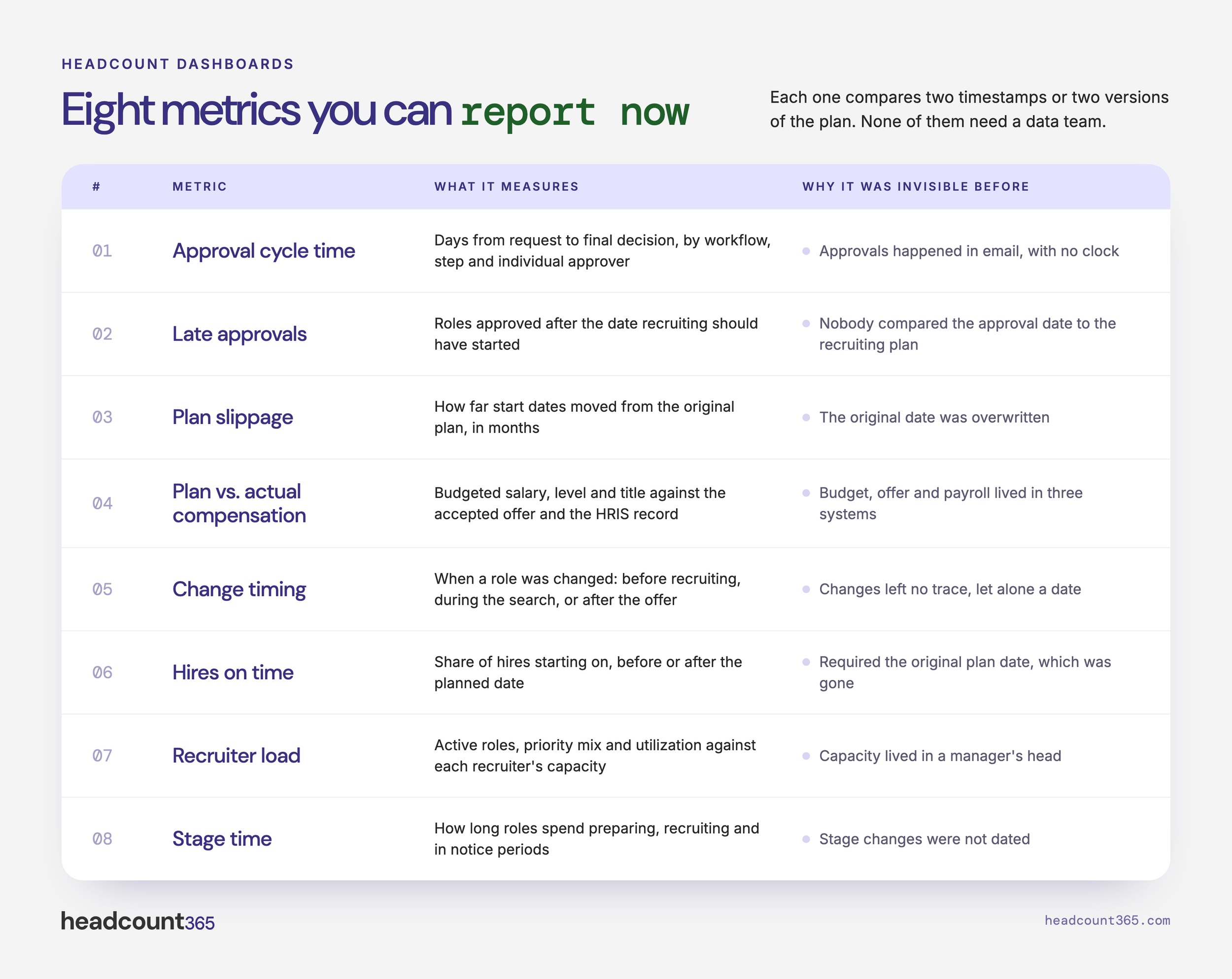
Two of these deserve a closer look, because they change the conversation the most.
Approval cycle time is the metric most leaders have never seen. Every organization believes its approvals are fast. Measured, the picture usually splits: most approvers respond within a day, and one or two steps account for most of the waiting. That turns a vague complaint ("approvals are slow") into a specific fix.
Plan vs. actual turns a budget into a story. When you hold the original plan, the current plan and the final outcome side by side, you can show not just that spend came in over, but where it drifted, when, and by whose decision.
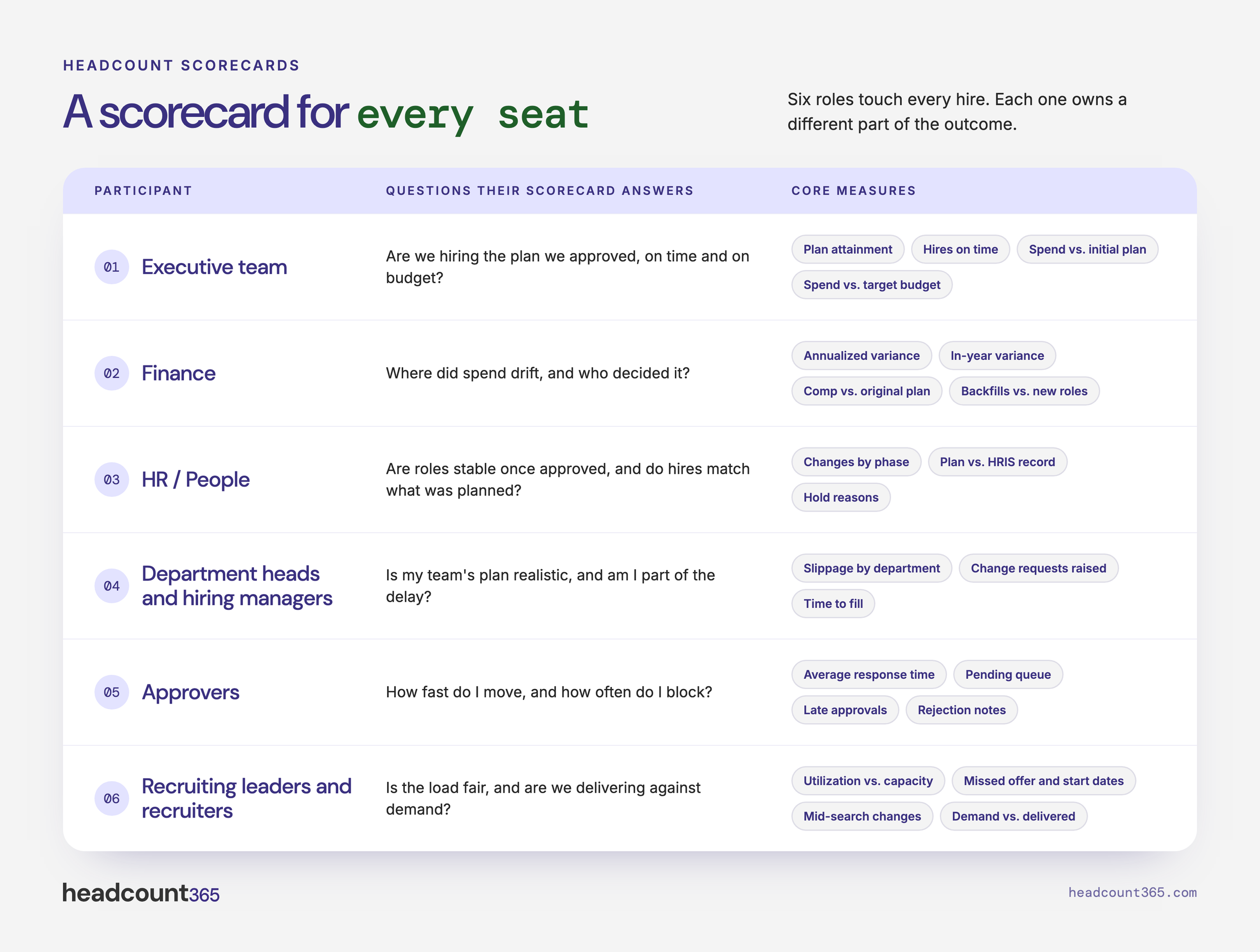
The approver scorecard is the one that surprises people. Approvers are rarely measured, because their work was invisible. Give a VP a monthly line that reads "average response: 4.6 days, team average: 1.2" and behavior changes without a single escalation.
The hiring manager scorecard does something similar for planning quality. A manager whose roles are changed after the search has started is costing recruiting time, and the data now shows it.
Three ways to use a scorecard: department, person, process
The same data supports three kinds of evaluation. Picking the right one keeps the conversation fair.
Evaluate a department
Start with plan quality, not hiring speed. Compare each department's original plan to its final outcome. A department that hit its headcount number but pushed half its start dates back four months did not deliver its plan. It delivered a different, later plan, and the business absorbed the cost of the gap.
Useful cuts: hires on time by department, slippage in months, compensation variance against the original plan, and change requests per approved role.
Evaluate a person
Score people on what they control. An approver controls response time. A recruiter controls offer timing on a role that stayed stable, but not on one whose level changed mid-search. A hiring manager controls how often their roles change after approval.
This is where timestamped history matters most. Without it, a late hire is blamed on whoever touched it last, usually the recruiter. With it, you can see that the role waited three weeks for approval and was re-leveled during the search.
Evaluate a process
Some problems belong to no single person. If one approval step adds five days to every request, the step is the problem, not the approver. If backfills take twice as long to approve as new roles, the policy may be asking the wrong questions.
Process scorecards look at averages by workflow and step rather than by name. They are the easiest to bring to an executive team, because they point at a fix rather than a culprit.
How to use headcount scorecards in an executive meeting
Executives remember the leader who explained what happened, not the one who reported it. Scorecards give you the evidence for that explanation. A simple structure turns them into a story:
The plan. What we committed to in January, frozen as it was.
The drift. Where reality moved away from it, in dates and dollars.
The cause. Which decisions, steps or teams drove the drift, with timestamps behind each claim.
The fix. One process change, with the metric that will show whether it worked.
Here is the difference in practice. A typical update says: "We are 12 hires behind plan." A scorecard-backed update says: "We are 12 hires behind plan. Seven of them waited more than two weeks at one approval step, and four were re-leveled after the search began. Removing that step and freezing levels at approval would recover most of the gap next quarter."
The second version does three things the first cannot. It shows command of the detail. It moves the discussion from blame to a decision. And it makes the person presenting it the obvious owner of the fix.
That last point matters for the people giving these updates. HR, Finance and Recruiting leaders are often judged on outcomes they share with a dozen other people. Scorecards make your contribution visible, and they show you are the one who can see across the whole process. That is how a functional leader becomes a strategic one.
What are headcount scorecard best practices?
History can't be produced after the fact. The approval that took nine days last spring is gone unless something recorded it at the time. The best time to start building scorecards is a full planning cycle before you want to present them.
Three steps get you started:
Freeze your starting plan. Whatever you approve at the start of the year, keep an untouched copy. It is the baseline every later metric depends on.
Put approvals on a clock. Move approvals out of email and chat and into a workflow that dates every request and response.
Connect the outcome. Link each approved role to its accepted offer in the ATS and its employee record in the HRIS, so plan vs. actual is a lookup and not a project.
Teams that run headcount in a dedicated planning platform such as headcount365 get this history automatically, because every change, approval and hand-off is recorded as it happens. Whatever tools you use, the principle holds: a headcount dashboard is only as good as the history behind it. Capture the history, and the scorecards, for every seat at the table, follow.
Headcount Scorecard FAQ
-
A headcount scorecard is a short, recurring view of one person's or team's part in the hiring process. A dashboard shows the whole plan. A scorecard shows what one participant controls, such as an approver's response time or how often a hiring manager's roles change after approval.
-
Six groups touch every hire, and each needs its own scorecard:
Executive team: are we hiring the plan we approved, on time and on budget?
Finance: where did spend drift, and who decided it?
HR: are roles stable once approved?
Department heads: is my team's plan realistic, and am I part of the delay?
Approvers: how fast do I respond?
Recruiting: is the load fair, and are we delivering against demand?
-
Count the days from the moment a headcount request is submitted to the final decision. Break it down by workflow, by approval step and by approver. You need the date of every request and response, which email and chat approvals don't record. Once it's measured, a common finding is that one or two steps cause most of the waiting.
-
Finance should track variance against the original plan, not just the current plan. That covers:
Annualized and in-year spend variance
Compensation changes compared with the budgeted salary and level
The mix of backfills vs. new roles
The savings and lost output when a vacant seat is closed rather than backfilled
The goal is to show where spend drifted, when, and whose decision caused it.
-
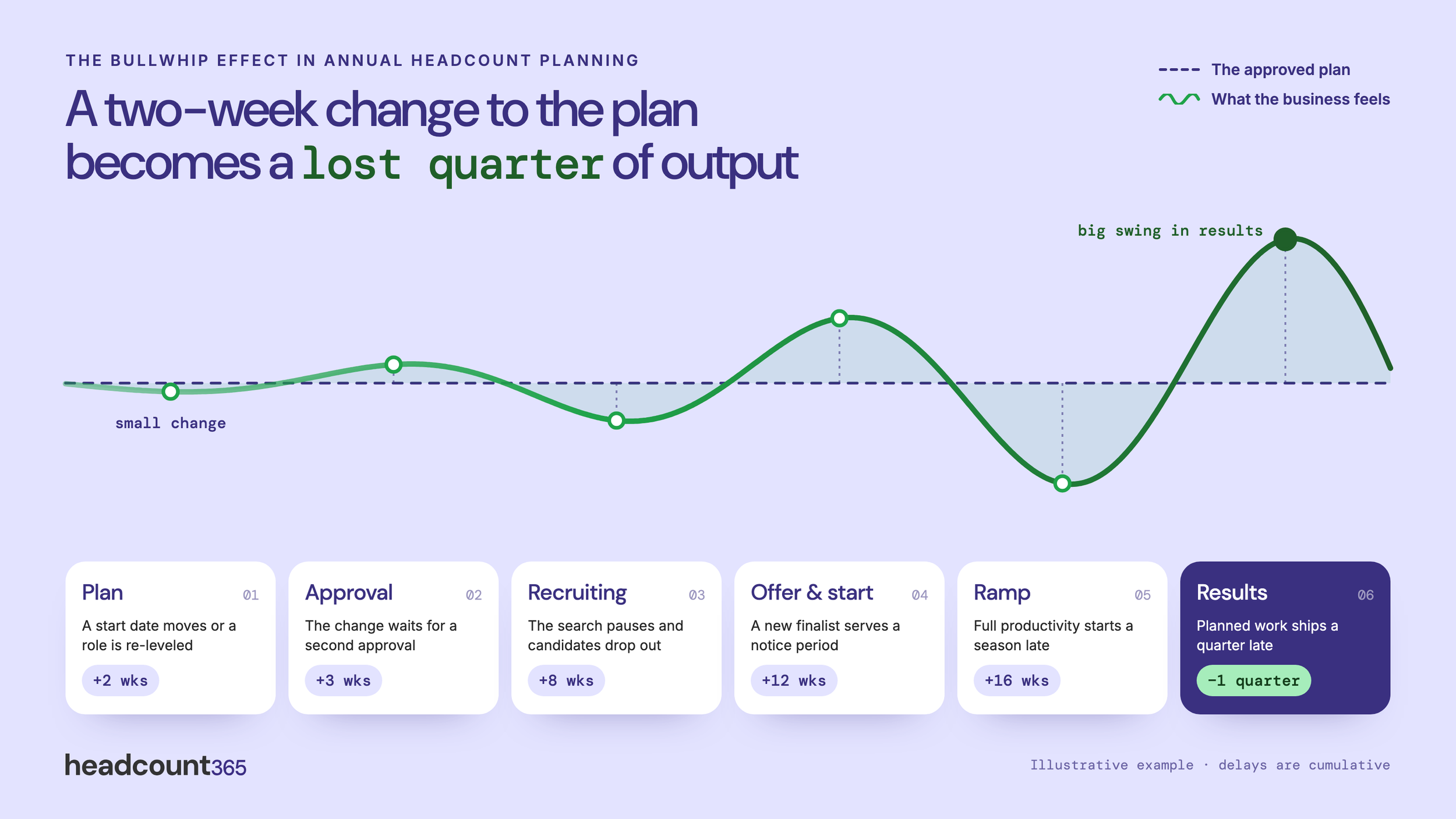
The bullwhip effect is when a small change early in a process causes a much larger swing further down. In headcount planning, a two-week change to a role can delay approval, pause the search, push back the start date and slow ramp-up. By the time it reaches results, the business can be a quarter behind. That's why it matters to measure when a plan changed, not only that it changed.
-
Pair each metric with one that pulls the other way, and score both teams on both:
Time to hire with first-year retention, so speed doesn't come at the cost of bad hires.
Headcount cost with the capacity delivered for it, so finance can't hit budget by leaving needed roles unfilled.
Plan changes with plan attainment, so the plan adapts to real conditions but doesn't move on a whim.
-
Review at least as often as your plan changes. If roles change monthly and you review quarterly, you're always two months behind and the gaps pile up without explanation. Most teams review scorecards monthly and check plan attainment more closely in Q4, when the year's plan is either met or missed.
-
They usually fail for three reasons:
A single function owns them while other teams drive the outcome.
Reviews happen less often than the plan changes.
The gap between plan and reality is never explained.
Shared scorecards, regular reviews and a dated history of every change fix all three.
-
Link each hire's records across the hiring plan, the ATS and the HRIS. Then compare what was planned and paid with how the person performed:
How quickly they reached full productivity
Performance against goals
Tenure and promotions
Because the records are linked, you can trace results back to the recruiter, the hiring manager and the budgeted salary. The hard part is joining data from separate systems, not defining the metric.