
Time to Fill as a SUPERPOWER
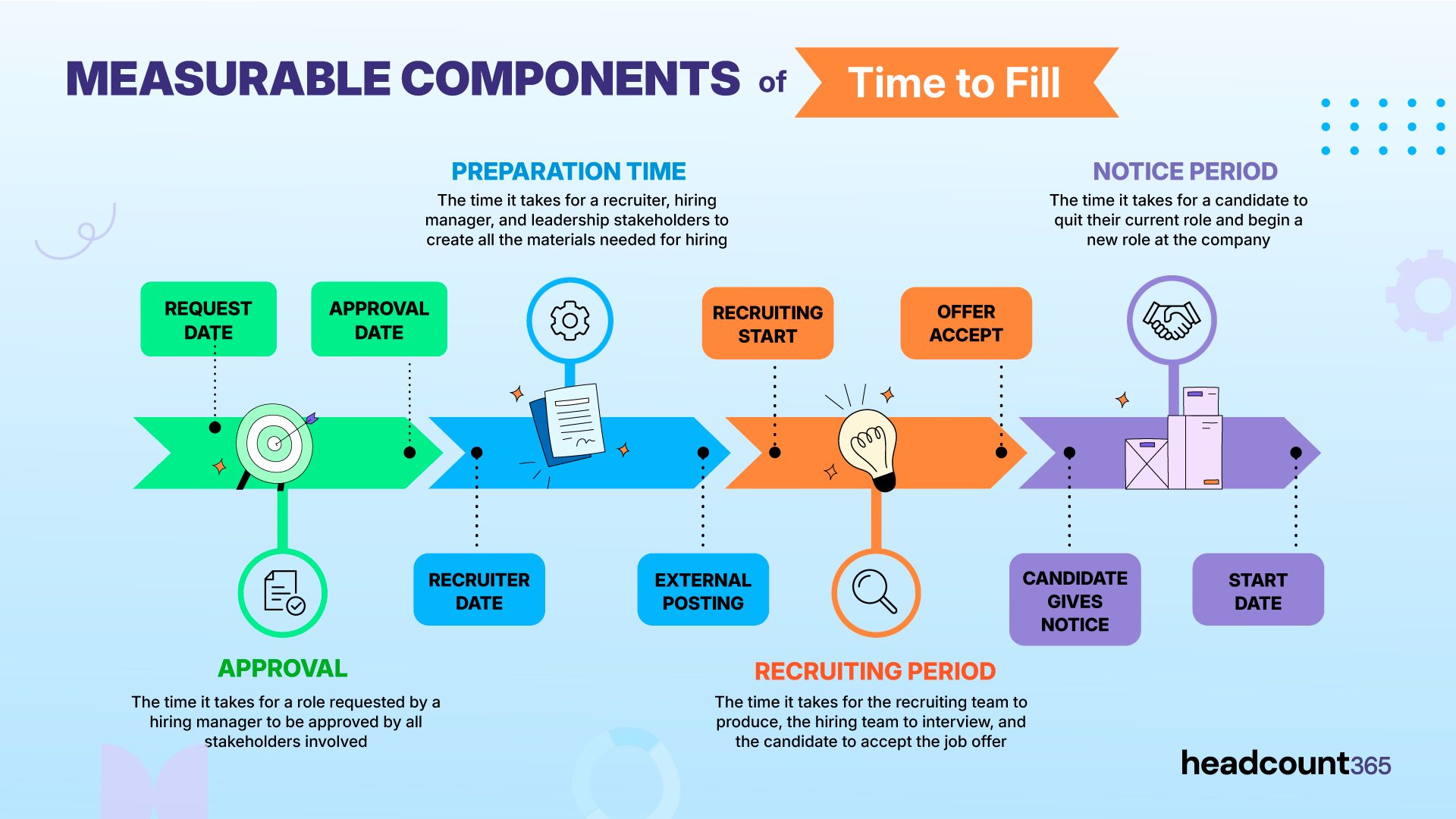
Table of Contents
Measurable Components of Time to Fill
To accurately predict and improve hiring speed, organizations must measure the four distinct phases of the recruitment timeline.
| Phase | Definition | Key Milestones |
|---|---|---|
| 1. Approval | The time it takes for a role requested by a hiring manager to be approved by all stakeholders involved. | Request Date to Approval Date. |
| 2. Preparation Time | The time it takes for a recruiter, hiring manager, and leadership stakeholders to create all the materials needed for hiring. | Recruiter Date to External Posting. |
| 3. Recruiting Period | The time it takes for the recruiting team to produce, the hiring team to interview, and the candidate to accept the job offer. | Recruiting Start to Offer Accept. |
| 4. Notice Period | The time it takes for a candidate to quit their current role and begin a new role at the company. | Candidate Gives Notice to Start Date. |
Measuring these components individually allows Talent Acquisition leaders to identify specific bottlenecks in the hiring process. Source: headcount365
A hiring manager requests a role on January 1st. Leaders approve the role on February 1st. The Recruiter was assigned the role and held the intake session on February 15th. The job was posted on March 1st. Which date do you use to begin calculating time to fill?
Time to fill is used throughout the recruiting industry as a way to measure recruiter performance, plan hiring, and communicate recruiting success. But without standardization, the time to fill metric can be perceived as a subjective way to highlight performance and is the main reason I see recruiting leaders lose credibility in executive meetings. Today we are going to show you how to standardize the metric and talk about how doing so helps answer the question above. First, we’ll divide the metric into four distinct segments, each with clear start and end times. Next we’ll review how each stakeholder can impact the length of time within these segments. Lastly, we’ll cover how to apply this metric in broader recruiting leadership tasks like planning and recruiter accountability.
Standardizing Time to fill
Time to fill is your metric to standardize as the recruiting leader. This means tracking key recruiting actions using a system like headcount365 or a manual process. Regardless of what system you use, key dates in the process should be timestamped, creating a segmented recruiting timeline that strengthens the value of the time to fill metric.
Request Date: The date a role is requested if new to the plan
Approval Date: The date a role is approved to be hired by the business
Assignment: The date a manager assigns a role to recruiter responsible for production
External Posting: The date the job description is posted to the ATS
Offer Accept: The date a candidate signs an offer letter
Start Date: The candidate’s first day as an employee
Average time to fill is a great storytelling metric, but rarely has enough detail to tell the full story. Our four time segments help a recruiting leader distribute accountability across all recruiting stakeholders for long or overdue timelines.
Approval Time: The time it takes for a new request (new to plan or backfill) to be approved for hire from executives, finance or other approvers
Preparation Time: The time between recruiter assignment and the role being posted on the company job board
Recruiting Time: The time between the date the role is posted on the company job board and the date an offer is accepted
Notice Period: The predicted time between a candidate quitting, and starting their new role
Segmented time to fill gives recruiting leaders SUPERPOWERS
Once you’ve standardized the definition of the components of the time to fill metric, you can apply the metric to improve your operational capability exponentially.
Credibility: Through clear articulation of actions and segments, you’re able to remove the “he said, she said” environment and allows you to control the time to fill narrative in a way that drives actions toward results and away from the subjective blame game
Problem diagnosis: Segments help you determine which process or stakeholders need help
Planning as a Superpower: Distinct time to fill helps you better distribute workload across your team, helping you understand when recruiting processes need to start
Lower average time to fill: With a standardized approach, unblocking time to fill issues with a more specific understanding of the time to fill metric means less time investigating and more time solving issues
Using your SUPERPOWERS during each time segment
Approval Times
Approvals require chat, email, and meetings to get the attention from approvers. Lack of context about the role, or its fit in the company could delay executive approval. Lack of context about the financial implication could delay financial approval.
Who to hold accountable: Hiring Managers, their executives, finance teams, the recruiting process.
What to look for: Ensure there is a clear request process and that all required information is captured before submitting for approval. Ensure executives are prioritizing approvals and have easy access to the information needed to make an approval. Ensure hiring managers are following the process and submitting all necessary information.
Preparation Time
Recruiters and hiring managers build a job description and interview rubric, define the interview process, and collaborate to produce the candidate experience.
Who to hold accountable: Recruiters, Hiring Managers, the recruiting process.
What to look for: Ensure there is a well documented and socialized process for a recruiting taking on a new requisition. Ensure your job description library is up to date and that any blockers to creating materials have a good escalation process. Ensure your recruiters are hitting Intake Session SLAs.
Recruiting Time
The time to generate top of the funnel applicants and move them through the funnel to an offer can be influenced by all stakeholders. This is obviously the most complicated segment to investigate, and often requires additional reporting that can help tell the full story.
Who to hold accountable: The recruiting funnel, recruiter, hiring managers, the business
What to look for: Ensure the company’s recruiting brand is generating top of funnel applications. Ensure recruiters are reviewing top of funnel applicants and are sourcing to fill in gaps. Review mid-funnel conversion rates for hiring manager alignment and offer accept rates for compensation & leveling attractiveness.
Notice Period
The time between a candidate's offer acceptance and their start date is dictated primarily by location, but also by job level and industry. Recruiting leaders should incorporate the variable nature of notice periods into their planning to ensure they can make hires on time.
Who to hold Accountable: Recruiting leaders, human resources.
What to look for: Ensure you are capturing notice period data and incorporating it into your planning timelines.
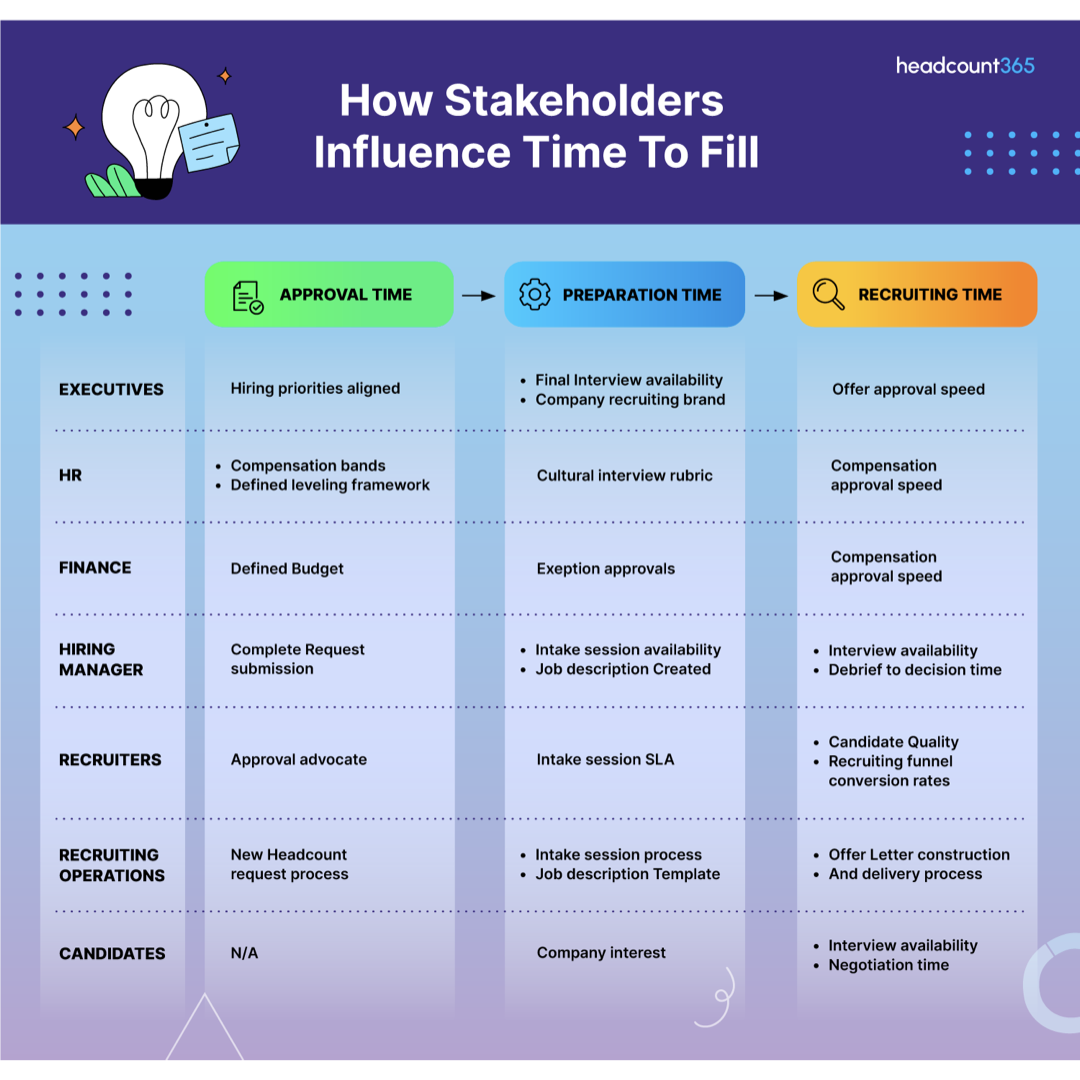
Time to fill isn’t a burden experienced solely by the recruiting team. By using a more structured approach to time to fill you are able to identify where stakeholders may be accountable and blocking progress.
How Stakeholders Influence Time to Fill
Hiring speed is a collective effort. This matrix identifies the specific responsibilities and influence points for every stakeholder in the headcount process.
| Stakeholder | Approval Time Influence | Preparation Time Influence | Recruiting Time Influence |
|---|---|---|---|
| Executives | Aligning hiring priorities. | Final interview availability and company recruiting brand. | Offer approval speed. |
| HR | Setting compensation bands and defined leveling frameworks. | Creating cultural interview rubrics. | Compensation approval speed. |
| Finance | Defining the budget. | Approving exceptions. | Compensation approval speed. |
| Hiring Manager | Completing request submissions. | Intake session availability and job description creation. | Interview availability and debrief-to-decision time. |
| Recruiters | Acting as approval advocates. | Maintaining intake session SLAs. | Candidate quality and recruiting funnel conversion rates. |
| Recruiting Operations | Managing new headcount request processes. | Standardizing intake processes and job description templates. | Offer letter construction and delivery process. |
| Candidates | N/A | Company interest levels. | Interview availability and negotiation time. |
Source: headcount365
Key questions answered with a standardized time to fill metric
Clear time segmentation of the recruiting life cycle does more than drive accountability. You can use time segments to proactively plan how your teams workload will impact their recruiting capacity. This proactive approach can help recruiting leaders advocate for the resources they need to operate a recruiting service that fulfills the demand of the business.
Key questions answered from a structured time to fill approach
Q: Is there a problem with my recruiting process?
A: When time based SLAs are missed, it is a broad indicator there can be an improvement in the process. They are an indication that you need to begin an investigation into a deeper issue, and drive accountability to return the SLA to within its normal range.
Q: When should my recruiters begin their work?
A: Average time to fill based workload planning lets you know when recruiters should start their work by working backwards to more accurately predict realistic start times.
Q: When will my recruiters be most burdened?
A: Time based workload planning helps clearly display which months have the most demand for offers. Time-based workload planning also displays the workload by recruiter over time, allowing for quick analysis of whats on each recruiter’s plate.
Q: How can external resources supplement my team?
A: Months with high demand for offers more easily warrant the use of external or supplemental resources and give operational leaders context as to the business case for this additional spend.
Q: Will I make hires on time?
A: Using a standardized time based planning methodology helps ensure that roles are not only filled, but they have the best chance of being filled by the time required by the business to hit broader goals.
Q: Who or what, is responsible for slow hiring?
A: Structured time to fill helps recruiting leaders focus on the key issues that slow hiring, and better distribute accountability across all stakeholders involved.
Using headcount365 to enhance time-to-fill
Requisition approval process: headcount365 has a customizable and integrated approval process that eliminates the need for email, chat programs, or 1:1 meetings to request or approve headcount on the hiring plan.
Direct connection to your ATS: headcount365 connects with your ATS system, logging posting dates and offer accept dates automatically.
Activity tracking: All requisitions have a log of activity to help understand how changes may impact the recruiting process.
Time based recruitment planning module: headcount365 automatically recommends recruiting start times, learning from your company’s time to fill performance so that your team can make hires on time.
Warnings for time based SLAs: headcount365 automatically flags requisitions falling outside of their anticipated SLAs to effectively guide action.
Time to fill reporting: headcount365 learns from the recruiting environment to accurately capture time to fill by each segment and level.