
Manage recruiting capacity like a PRO
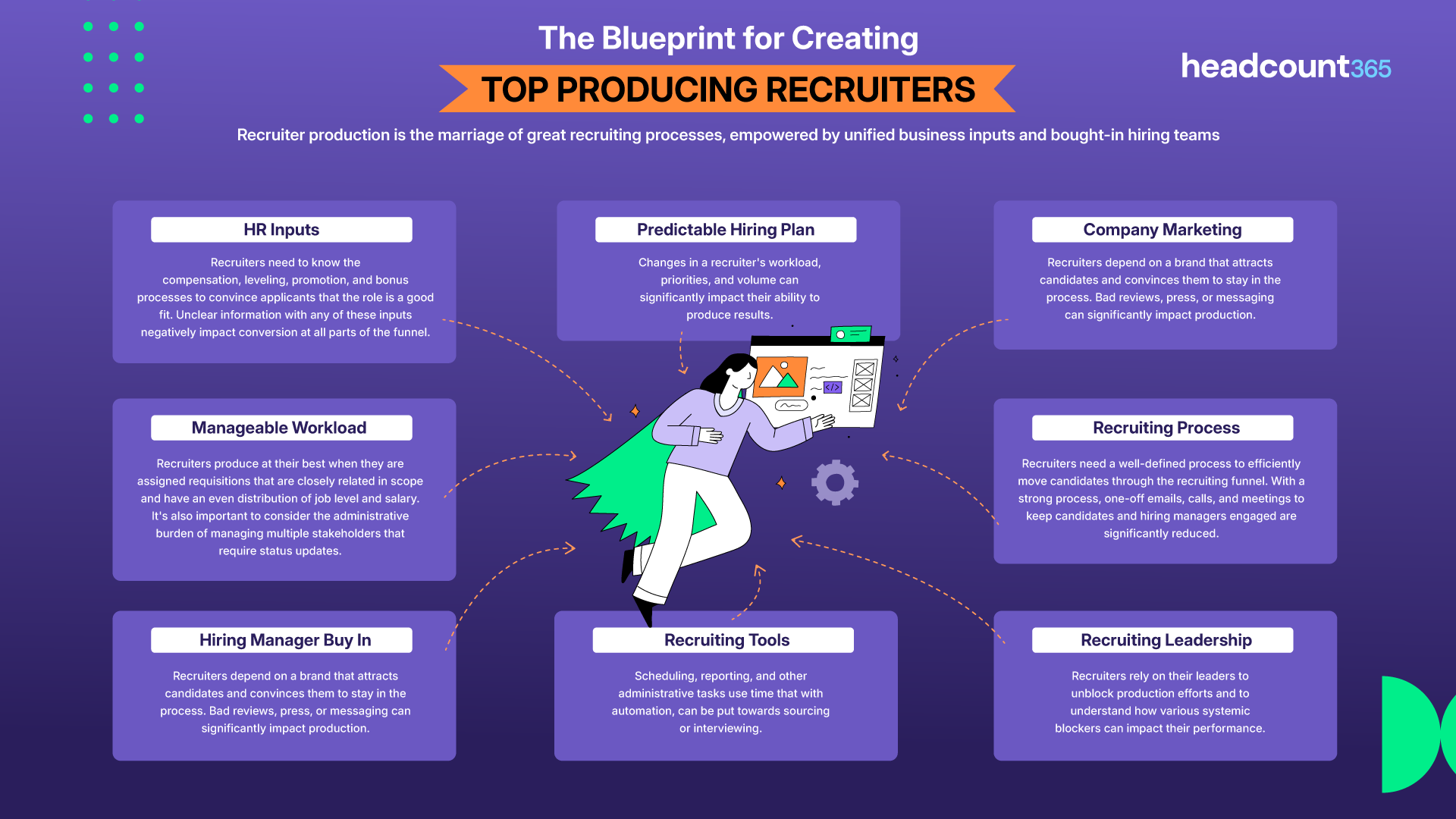
Table of Contents
The Blueprint for Creating Top Producing Recruiters
Recruiter production is the marriage of great recruiting processes, empowered by unified business inputs and bought-in hiring teams.
| Pillar | Description & Impact on Production |
|---|---|
| HR Inputs | Recruiters need clarity on compensation, leveling, promotion, and bonus processes to convert applicants effectively. |
| Predictable Hiring Plan | Workload stability is key; frequent changes in priorities or volume significantly hinder the ability to produce results. |
| Company Marketing | A strong brand attracts and retains candidates; negative press or poor messaging directly impacts funnel production. |
| Manageable Workload | Recruiters perform best with related requisitions and an even distribution of job levels/salaries to reduce administrative friction. |
| Recruiting Process | A well-defined process reduces "one-off" communications and keeps both candidates and hiring managers engaged. |
| Hiring Manager Buy-In | Success depends on a collaborative partnership where hiring managers are aligned with the talent brand and recruitment goals. |
| Recruiting Tools | Automation of scheduling and reporting allows recruiters to spend more time on high-value tasks like sourcing and interviewing. |
| Recruiting Leadership | Leaders are responsible for unblocking production efforts and understanding systemic blockers that impact team performance. |
Source: headcount365
How many hires should recruiters make each month?
Managing recruiting capacity is critical to creating a predictable hiring environment. Overstaff your team and costs run high. Understaff and you’ll miss hire dates impacting production & revenue. So how many requisitions should you ask a recruiter to fill in a month? Let’s focus on the three key areas you can influence as a Recruiting Leader
Company Recruiting Maturity: Does the company provide a brand that attracts top of funnel, a transparent compensation framework, and a culture where hiring managers are bought in?
Requisition Workload: Do requisitions require high effort from recruiters to fill the funnel and manage the process?
Hiring Plan Changes: Is the hiring plan predictable or is every requisition a scramble, with moving goal posts that have recruiters spinning wheels?
Company Recruiting Maturity Impacts Recruiter Capacity Models
Key Inputs to the Recruiting Process
Company Brand & Marketing- Can your company attract candidates at the top of funnel
Company Compensation Philosophy - Is your company competitive with compensation
Hiring Manager Buy In- Do your hiring managers prioritize recruiting
Headcount Plan Change Rate - Is your business able to create a predictable demand plan for the business
Changes to hiring plans increase the amount of administrative tasks in a recruiters workload, decreasing their ability to produce
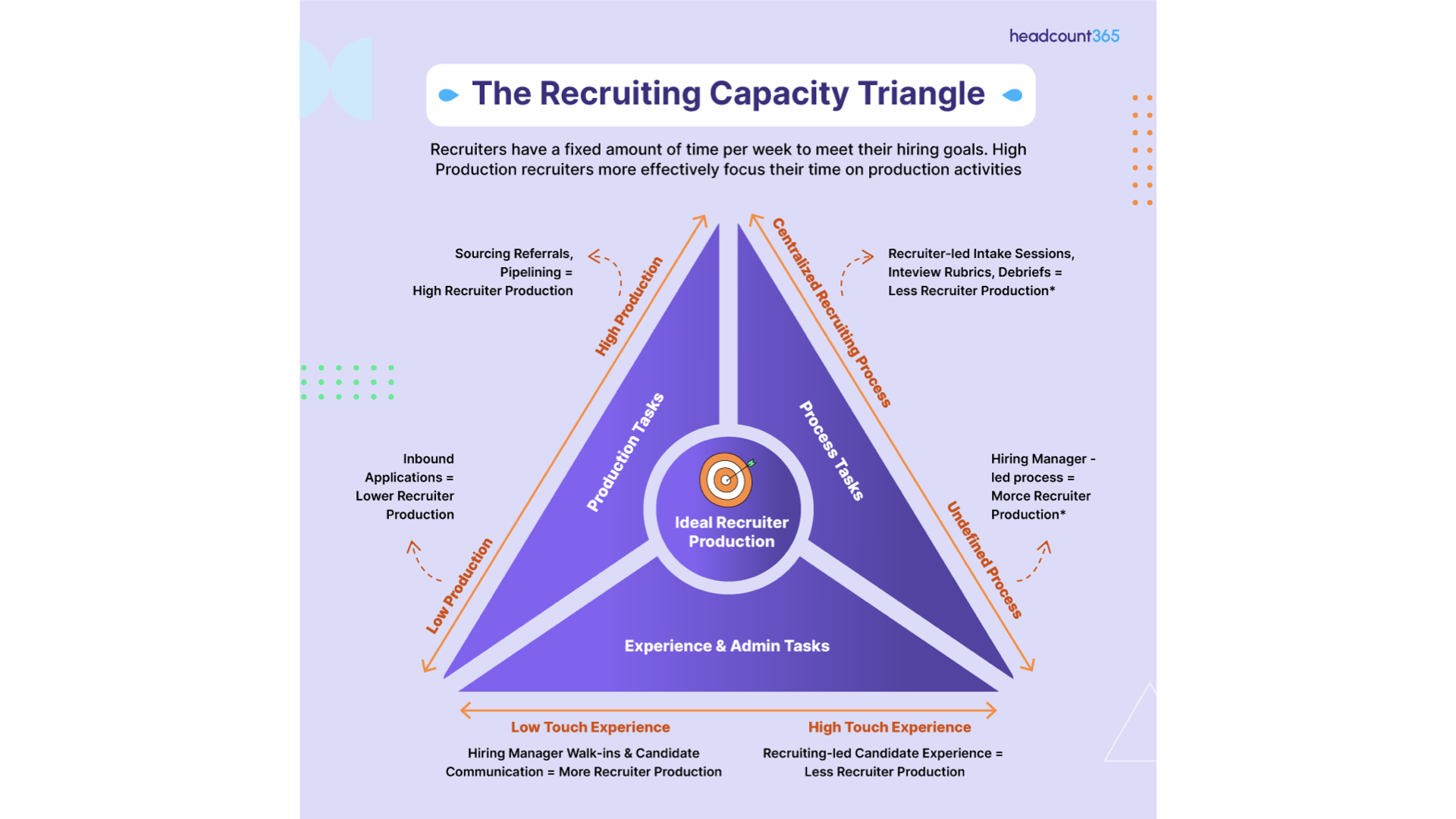
The Recruiting Capacity Triangle
Recruiters have a fixed amount of time per week to meet their hiring goals. To reach "Ideal Recruiter Production," teams must understand how different activities impact their total capacity.
| Task Category | High-Production Activities | Capacity-Intensive Activities (Less Production) |
|---|---|---|
| Production Tasks | Sourcing, Referrals, and Pipelining. | Managing Inbound Applications. |
| Process Tasks | Hiring Manager-led processes (Undefined Process). | Recruiter-led Intake Sessions, Interview Rubrics, and Debriefs (Centralized Process). |
| Experience & Admin Tasks | Low Touch: Hiring Manager walk-ins and direct candidate communication. | High Touch: Recruiting-led candidate experience and extensive administrative management. |
Key Insight: High-production recruiters more effectively focus their time on sourcing and production activities by offloading or streamlining process and admin tasks.
Source: headcount365
How your company’s recruiting readiness impacts hiring production:
Recruiting readiness impacts funnel conversion rates:
Application rates: A great company brand drives inbound applications without sourcing effort.
Source to applicant rates: Recruiters who can articulate the job level and compensation in a way that can be compared to a candidates existing job will increase the number of passive candidates who convert to active. candidates
Mid funnel conversion rates: Hiring managers aligned to a company wide leveling framework will eliminate individual perceptions of title and focus more on candidate fit. Participants who fill out scorecards and give good feedback help recruiters hone in on ideal target profiles.
Offer to accept ratio: Recruiters with clear job levels and compensation can pre-close candidates, eliminating candidates who should never have been in the process in the first place.
Recruiting readiness decreases the administrative time of Recruiters:
Less time pricing roles, chasing scorecards, and handling post offer activities means more time for production activities like sourcing and interviewing.
How to improve the recruiting maturity of your business
Influencing the company recruiting readiness can be a slow process, but understanding these inputs will allow you to incorporate them into your OKRs and manage current expectations about production. Driving accountability to hiring stakeholders is a key factor in running a productive recruiting business.
Partner with HR to define job leveling & compensation frameworks.
Track backfills & incorporate them into future capacity and demand planning.
Track hiring manager activity and drive accountability with executives.
90%+ Scorecard completion rate.
Less than 72 hours between final interview & offer being extended.
Partner with marketing to drive unified external branding effort.
Requisition Workload Impacts Recruiting Capacity Model
Perhaps the biggest influence on the individual recruiter capacity model is how hard their work is to complete. In the simplest example, a recruiter with 10 entry level sales roles for a single manager, does not do the same amount of work as a recruiter with 10 director level positions across multiple executives.
The amount of effort a role takes to source, interview, and hire can be measured and used to ensure an even distribution of work across your team.
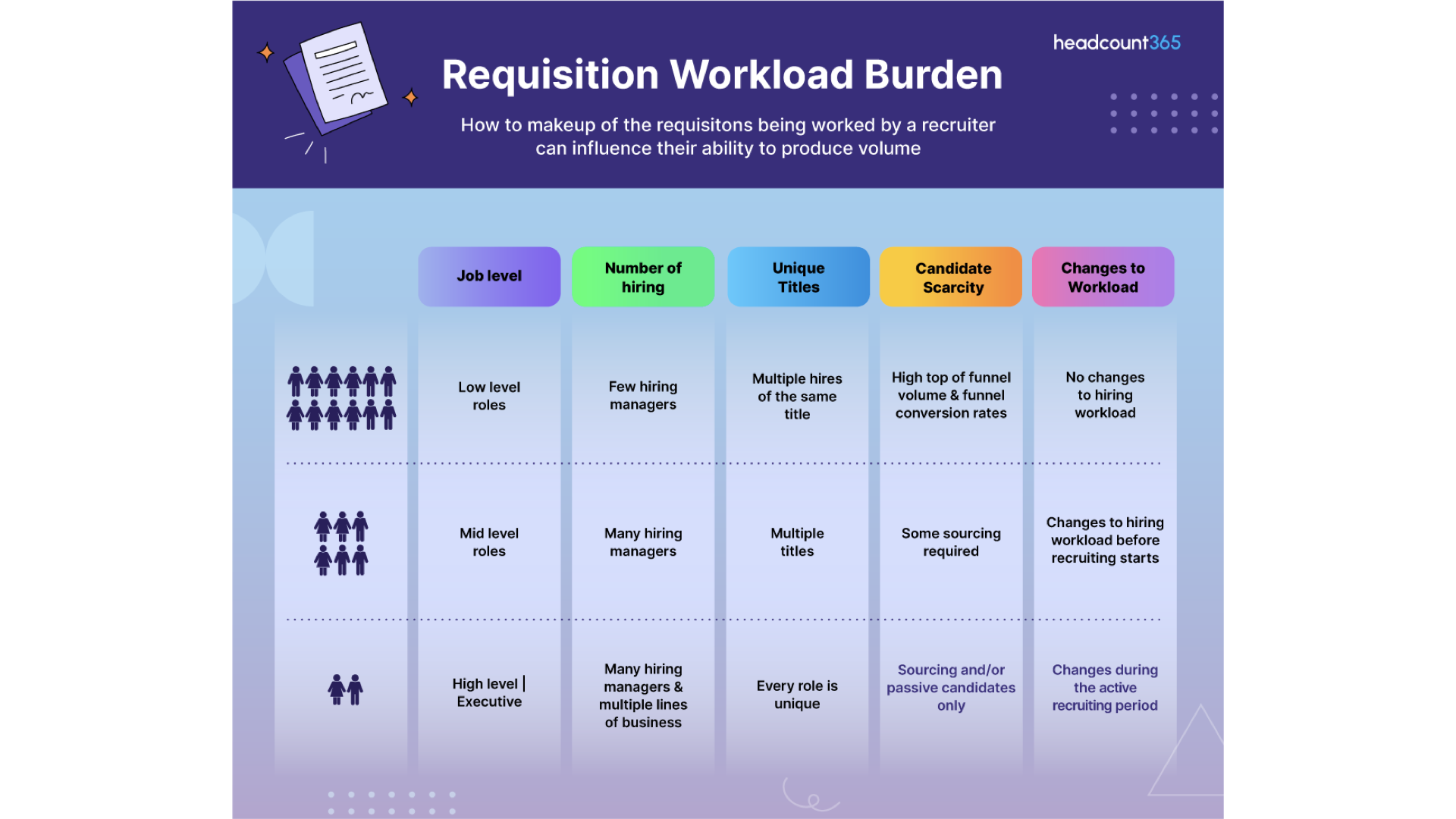
Requisition Workload Burden: Impact on Recruiter Production
The makeup of the requisitions being worked on by a recruiter influences their ability to produce volume. Production is highest when roles are standardized and lowest for complex, executive-level hiring.
| Job Level | Number of Hiring Managers | Unique Titles | Candidate Scarcity | Changes to Workload |
|---|---|---|---|---|
| Low-level roles: Higher production volume possible. | Few hiring managers involved. | Multiple hires of the same title (Standardized). | High top of funnel volume and high conversion rates. | No changes to the hiring workload. |
| Mid-level roles: Moderate production volume. | Many hiring managers involved. | Multiple titles across the workload. | Some sourcing and specialized effort required. | Changes to hiring workload occur before recruiting starts. |
| High-level | Executive: Lowest production volume. | Many hiring managers and multiple lines of business involved. | Every role is unique. | Sourcing and/or passive candidates only (High Scarcity). | Changes occur during the active recruiting period (High Volatility). |
By understanding these burdens, talent leaders can more accurately forecast recruiter capacity and set realistic production targets.
Source: headcount365
How requisition workload burden impacts monthly production:
The complexity of hiring demand can impact hiring production in a number of ways.
Funnel volume: Different roles and functions impact top of funnel volume, requiring spend, and sourcing to generate the same amount of hires.
Recruiter effort: High priorities and low funnel volume increases sourcing needs for recruiters. Recruiters with multiple job titles or departments don’t benefit from the economies of scale of talent pools.
Administrative effort: More hiring managers means more updates, administrative emails & service takes time away from sourcing, interviewing and other production related activities.
What you can do about it:
Recruiting pods: Grouping your recruiters into pods of like roles helps increase recruiter capacity based on their area of focus, allowing you to more freely distribute an even workload burden amongst grouped recruiters.
Real-Time burden tracking: This is where a tool like headcount365 shines. As a recruiting leader, real-time tracking helps you monitor each recruiter’s workload burden in real time, and helps to appropriately assign requisitions to keep an even distribution of level, priority, titles, and managers. This data does not only help distribute workload of active requisitions, but improves the precision of a recruiting scorecard during review time.
Hiring Plan Changes Impact Recruiting Capacity
Recruiting teams can produce more hires when a hiring plan is predictable. Unforeseen plan reforecasts & individual requisition changes, impact the hiring speed causing a timing reset on the clock for time to fill. Reliable attrition forecasts can help understand unplanned demand and ensure proper recruiter staffing.
As a Recruiting Leader, you must influence the business to provide you the information needed to empower your recruiter’s success!
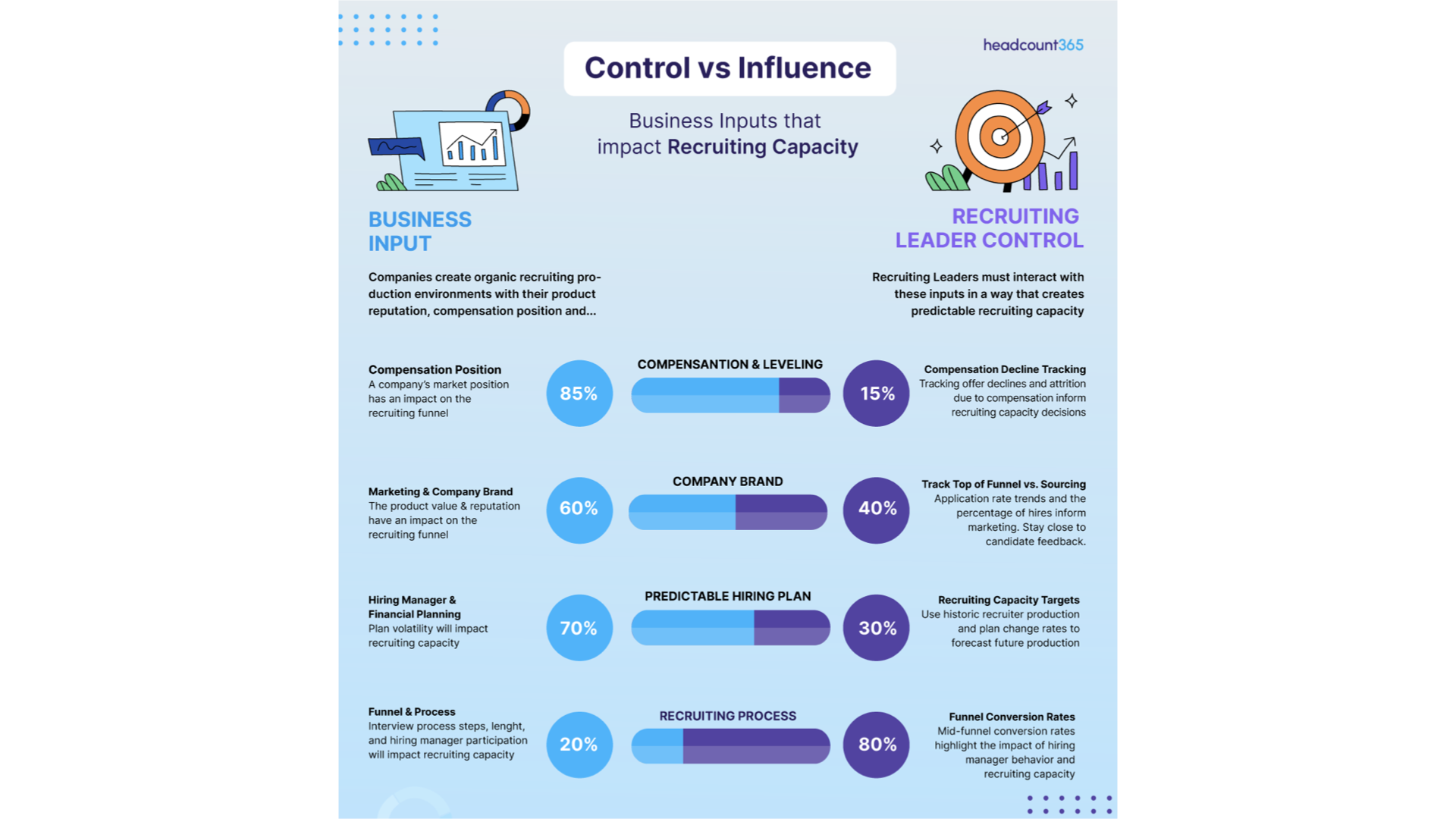
Control vs Influence: Business Inputs that Impact Recruiting Capacity
Recruiting leaders must navigate organic production environments created by the company's reputation and financial position to create predictable recruiting capacity.
| Category | Business Input (Influence) | Recruiting Leader Control |
|---|---|---|
| Compensation & Leveling | 85% Influence: Market position impact on the funnel. | 15% Control: Tracking offer declines and attrition to inform decisions. |
| Company Brand | 60% Influence: Product value and market reputation impact. | 40% Control: Tracking top of funnel vs. sourcing and candidate feedback. |
| Predictable Hiring Plan | 70% Influence: Financial planning and manager volatility impact. | 30% Control: Setting capacity targets using historic production and change rates. |
| Recruiting Process | 20% Influence: Length and manager participation impact. | 80% Control: Managing mid-funnel conversion rates and manager behavior. |
Insight: While recruiters have the most direct control over the "Recruiting Process" (80%), they are heavily influenced by "Compensation & Leveling" (85% external), necessitating deep tracking to influence those broader business decisions.
Source: headcount365
How changes impacts Recruiter Capacity:
If you want a different flavor of a cake, it’s a lot easier to change before you start baking than while it’s in the oven. Plan changes should trigger a restart of the “recruiting time” clock (Check out our time to fill article for details), especially if the recruiter is actively working on the role.
Time to fill: Unplanned changes will have a negative impact on recruiting timelines.
Administrative time: Tracking changes and ensuring they are tied to both the ATS and the financial plan is time intensive. This work typically falls on the HRBP or recruiting leaders who are responsible for plan management.
Recruiter capacity & demand: Unplanned backfills add unplanned workload to a recruiter’s plate and may require agencies, or re-prioritization to ensure the right roles are filled.
What you can do about it:
Track Changes: The best tool for tracking the changes to a hiring plan is headcount365. The system is designed to track all modifications with a proactive approval process and activity log, ensuring the timing and reasoning for changes are captured. Additionally, backfill forecasts are prebuilt into the demand and capacity plan so recruiting leaders can be proactive about the recruiting team’s ability to support the additional demand. Lastly headcount365 reports on changes in a proprietary way that helps recruiting leaders drive accountability with hiring stakeholders.
If you don’t have headcount365, you can add a change tracking column to your spreadsheet-based headcount plan to have an idea of how many requisitions are changing in a given headcount forecast.
The headcount365 recruiting capacity module streamlines the entire workflow
The headcount365 platform is built to automate recruiter capacity predictions learning from the requisition, change, and ATS data in real time. With features like a live capacity/demand forecast, historic reporting, and predictive start dates, Recruiting Leaders can create more accurate recruiting capacity models, and create predictable hiring for their executives.