
Beyond the Spreadsheet: Balancing Recruiting Capacity with Enterprise Headcount Demand
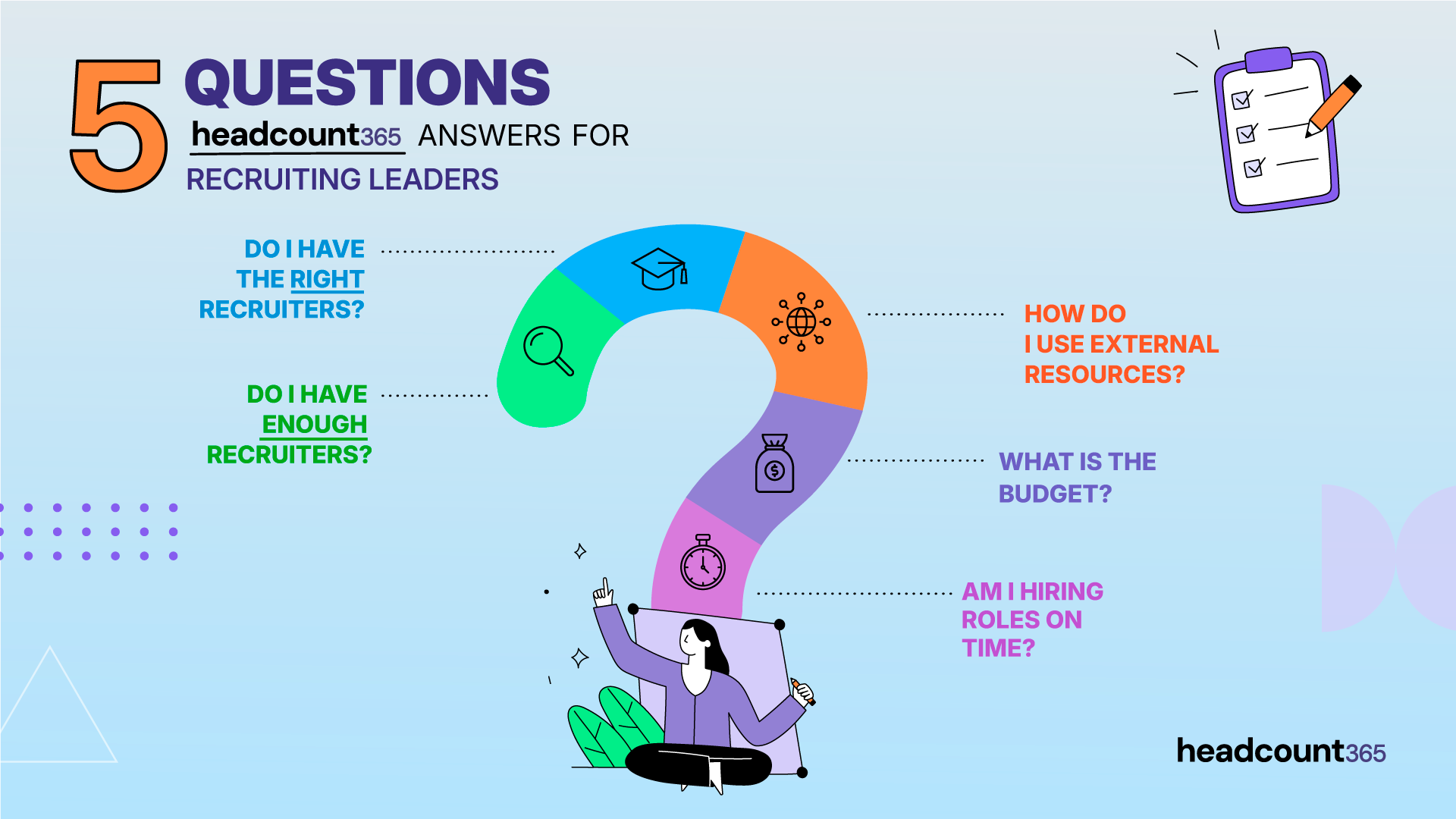
Table of Contents
5 Questions headcount365 Answers for Recruiting Leaders
Recruiting leaders face complex challenges in balancing team capacity with business demand. headcount365 provides the data needed to answer these five core questions:
- Do I have the RIGHT recruiters? – Evaluate team skill sets against the specific needs of the current hiring plan.
- Do I have ENOUGH recruiters? – Determine if current team capacity can meet the volume of open requisitions.
- How do I use external resources? – Decide when to leverage agencies or contractors based on capacity gaps.
- What is the budget? Impact of hiring? – Understand the financial footprint of the hiring plan and the cost of every new hire.
- Am I hiring roles on time? – Track performance against forecasted start dates to ensure organizational growth isn't stalled.
By answering these questions with real-time data, talent leaders can move from reactive hiring to proactive workforce management. Source: headcount365
For talent operations and talent acquisition leaders, the most critical question you must answer for the executive team is deceptively simple: Do we have the resources required to execute our hiring plan?
Historically, answering this required a mountain of manual tracking, static spreadsheets, and guesswork based on historical time-to-fill averages. But hiring plans are dynamic, non-linear, and constantly shifting. To manage them effectively, organizations must shift from reactive tracking to proactive resource orchestration.
Here is how Headcount365 transforms standard recruiting capacity from a guessing game into a predictable mathematical framework.
5 Recruiting questions answered by headcount365
1. Recruiting Capacity vs. Hiring Demand
Do I have enough recruiters to meet the hiring demand of the business?
Legacy capacity planning relies on basic arithmetic: taking your total open requisitions and dividing them evenly among your recruiters. This approach fails to account for varying role complexities, differing historical pipeline velocities, or changing market conditions.Headcount365 is the first platform to visualize real-time recruiting capacity directly against active hiring demand.
By leveraging historical platform velocity and time-to-fill data, our system plots projected offer dates on top of historical monthly fill performance. This allows talent leaders to clearly demonstrate to executive stakeholders whether the team is properly staffed to execute the business's growth goals.
Read more about headcount365’s Headcount Analytics & Management benefits from our blog
2. Recruiter Performance Beyond Basic Metrics
Are my recruiters performing to the capacity expectations set?
Evaluating a recruiting team solely on basic outcomes, like total hires or raw time-to-fill, tells an incomplete story. It ignores the actual operational burden placed on individual recruiters, often rewarding those with simple requisitions while penalizing those tackling highly complex, critical roles.
Our platform eliminates spreadsheet-based performance tracking by overlaying objective output metrics with real-world complexity variables. Recruiting managers can view a comprehensive, data-driven story of an individual recruiter's workload, analyzing metrics such as:The volume of high-priority enterprise requisitions.The complexity index of specific role bands.The frequency of scope changes made to active requisitions by hiring managers. By tracking these inputs, Headcount365 makes it simple to reward performance objectively, prevent team burnout, and allocate resources based on true bandwidth.
3. Strategic Workload Distribution & Forecasting External Resources
Is the recruiting workload equitably spread across recruiters?
In a perfect world, hiring demand would be linear, perfectly distributed month over month. In the real enterprise environment, hiring demand arrives in waves, clusters, and sudden surges. When demand spikes past internal capacity, talent leaders must strategically utilize external agencies without blowing their operational budgets.Instead of reacting to a backlog after it occurs, Headcount365 dynamically highlights upcoming capacity deficits.
The platform automatically calculates the forecasted budget implications of leveraging external resources. This gives recruiting leaders the predictive insights needed to pitch external spend to executive teams before hiring timelines begin to slip.
4. Automated Financial Reconciliation: Eradicating the Spreadsheet Gap
What is the budget impact of hiring?
When Finance and Recruiting track headcount in separate, offline systems, data drift is inevitable. Requisitions get opened without strict budget authorization, start dates shift without Finance’s knowledge, and millions of dollars in corporate capital end up un-reconciled.
By establishing a unique, immutable ID for every position, Headcount365 creates a live bridge between your applicant tracking system (ATS) and Finance's system of record. Our framework uses the predicted start dates of every active requisition on the hiring plan to calculate real-time payroll variance. This automated reconciliation ensures that any capital saved from delayed offer dates can be instantly reallocated to supplement recruiting resources where they are needed most. This is one of the key benefits of using headcount Software vs. Spreadsheets for financial reconciliation.
5. Predictive Recruiting Velocity: Engineering On-Time Starts
Will the business get their hires on time?
A hiring plan is only successful if new hires are sitting in their seats by the exact date the business requires them. Yet, most talent teams lack the system intelligence to tell hiring managers exactly when a requisition must be opened to hit its target start date.Headcount365 tracks the entire position lifecycle to tell talent leaders whether requisitions are tracking toward an on-time start. By processing historical recruiter velocity, background check latency, and hiring manager response times, our engine accurately forecasts when a role must enter the recruiting pipeline. This brings consistent, predictable execution to the business's scaling strategy.
Transition to True Orchestration with headcount365
Managing recruiting capacity isn't just about managing recruiters—it’s about aligning human output with financial reality. To learn more about the operational principles and system structures that automate these workflows, explore The Headcount Orchestration Methodology.