
Preparing your HR & TA Data for AI: 5 Best Practices
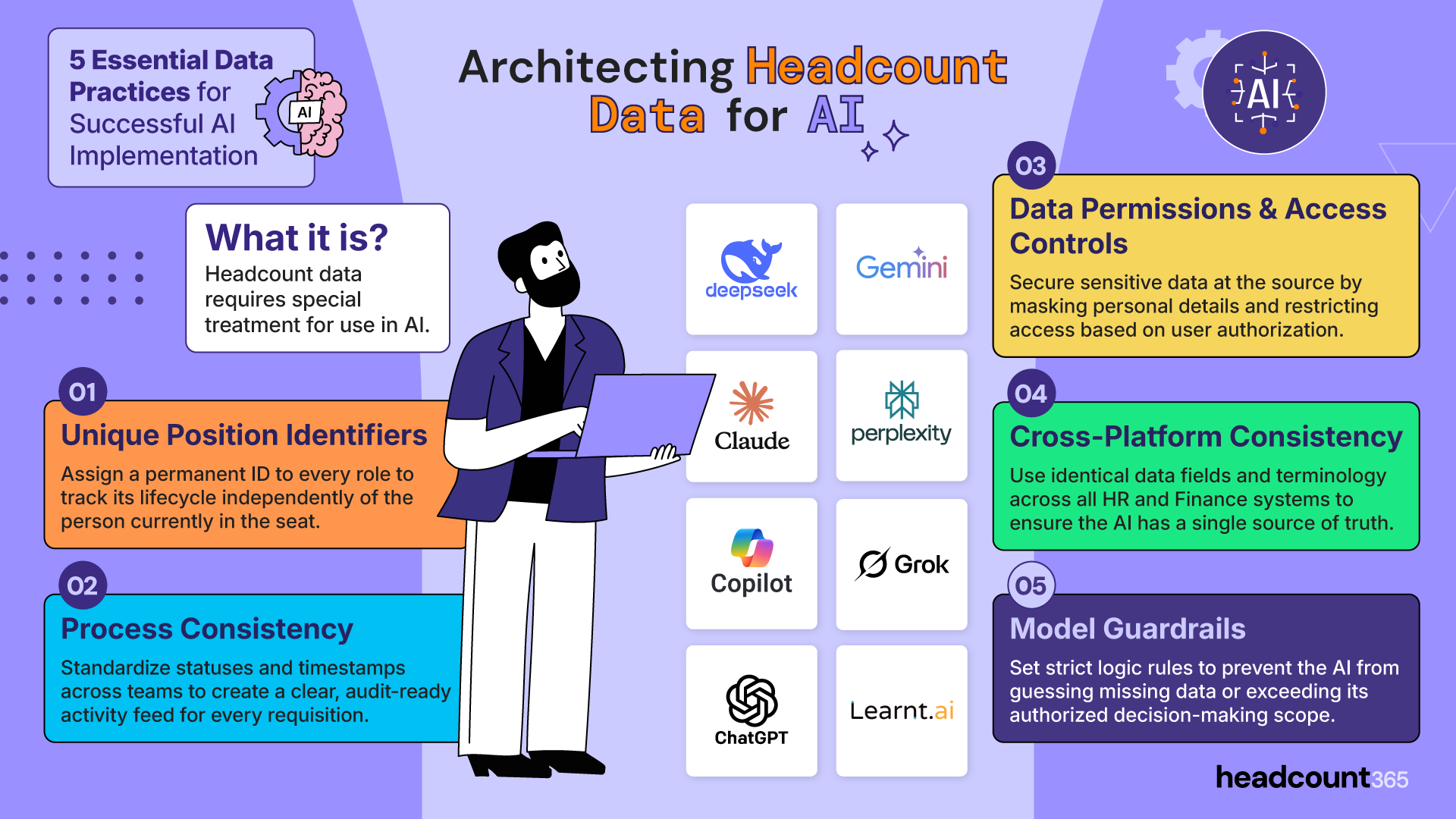
Table of Contents
5 Essential Data Practices for Successful AI Implementation
Headcount data requires special treatment for use in AI. Below are the five core pillars for architecting this data.
| Step | Practice Name | Description |
|---|---|---|
| 01 | Unique Position Identifiers | Assign a permanent ID to every role to track its lifecycle independently of the person currently in the seat. |
| 02 | Process Consistency | Standardize statuses and timestamps across teams to create a clear, audit-ready activity feed for every requisition. |
| 03 | Data Permissions & Access Controls | Secure sensitive data at the source by masking personal details and restricting access based on user authorization. |
| 04 | Cross-Platform Consistency | Use identical data fields and terminology across all HR and Finance systems to ensure the AI has a single source of truth. |
| 05 | Model Guardrails | Set strict logic rules to prevent the AI from guessing missing data or exceeding its authorized decision-making scope. |
Featured AI Platforms: DeepSeek, Gemini, Claude, Perplexity, Copilot, Grok, ChatGPT, Learnt.ai.
Source: Headcount365
Why headcount data needs special treatment for AI
Headcount is a unique cross-functional challenge because no single system holds the complete source of truth. Finance owns the budget; the HRIS houses position data and attrition; Compensation maintains the job library; and Recruiting manages the status of open roles and backfill requests.
Preparing this data for AI agents is less about "data cleaning" and more about digital cartography. You aren't just scrubbing spreadsheets; you are mapping how value and headcount flow through your organization. By defining where these systems overlap, you create clear ownership over critical data and processes.
This article focuses on building a "Dewey Decimal System" for your headcount data. Without a structured indexing method, an AI agent is forced to hallucinate its way to a solution. To give an agent the ability to act on your behalf, you must first provide the organizational framework it needs to navigate your data accurately.
5 Best Practices to Prepare Headcount Data for Use in AI Models
1) Unique IDs for Headcount Data
The accuracy and productivity of an AI agent are directly impacted by how well a company’s position management system is maintained and the breadth of data it stores. For basic utility, a system that simply links an Employee ID to a Requisition ID may allow an agent to perform single plan-year tasks. For outputs that consider longer history than a single year the position management system must serve as a comprehensive historical record for every "seat."
The more robust the position tracking, the more the AI agent gains the scope necessary to move beyond simple data retrieval. This expanded data scope allows the agent to generate precise predictions and actionable recommendations based on the actual maintenance history of your organizational design, rather than just a snapshot of current staff.
Implementing Unique Identifiers for AI
The Best Practice: Implement a Global Entity ID (GEID). This is a metadata tag that follows a "work object" across systems. Choose a singular system of record and define processes to add, eliminate, and trade Ids.
How it works: For every headcount, a unique ID is generated. Even if the data moves from Anaplan, to Greenhouse to BambooHR that identifier follows.
The AI Benefit: This allows the agent to perform Traceability Reasoning. It can answer: "Why was this hired delayed?" by looking back at the specific approval chain, requisition activity feed, or hiring pipeline linked to that GEID.
2) Process Consistency
Because AI agents are most effective at identifying outliers and recognizing patterns, a standardized pattern must exist for every critical process that impacts headcount. If an agent is tasked with creating, modifying, or recommending changes to headcount, it must reference a consistent library of change processes and understand the distinct states within each workflow.
Core Headcount Processes that Require Consistency for AI
Key Requisition & Employee Statuses: Define a universal status set (e.g., "Draft," "Approved," "Active," "On Leave," "Sunset") so the agent can accurately interpret the state of a seat at any moment.
Standardized Reasons for Change: Every headcount modification needs a specific code (e.g., "Department Reorg," "Budget Adjustment," "Backfill"). This allows the agent to distinguish between routine maintenance and strategic shifts.
Approval Lineage: The agent must be able to track the chain of command for every change. If an agent recommends a new hire, it needs to know exactly which approval workflow to trigger based on the department or budget level.
Job Titles, Libraries & Codes: Consistent use of job codes ensures the agent doesn't treat "Software Engineer" and "SW Engineer" as two different functions.
3) Data Permissions & Access Controls
Without a system like headcount365 to permission data access for individual users, including an AI Agent, you need to set standards for what source files an AI can access to do its work.
Compensation teams don't want to share CEO salary with every employee, but AI should automate compensation predictions. Finance doesn't want to show the Revenue Scenarios but do want teams to scenario plan using fully burdened headcount costs.
Theres a reason why companies don't allow every employee a license to every system (cost aside). This is one of the core benefits of headcount365.
Headcount Data Security Best Practices for AI
The Best Practice: A managed export data lake for AI agents. The control is to never give access to an agent that doesn’t need it.
Role-Based Access Control (RBAC) for Agents: Treat the AI agent like an employee. It should have its own credentials with the absolute minimum permissions required to function.
Data Masking & PII Stripping: Before data hits the LLM or the vector database, use a middleware layer to redact Personally Identifiable Information (PII).
Differential Privacy: If you are training or fine-tuning, add "noise" to the dataset so the AI can learn patterns without "memorizing" specific sensitive records.
4) Cross Platform Consistency
Cross-platform consistency is the bedrock of a reliable headcount dataset, and it manifests in two critical forms: Corporate Taxonomy and Action Tagging. When data structures do not match, an AI agent is forced to "hallucinate" its way to the most likely conclusion, which is unacceptable for decisions impacting people data.
Corporate Taxonomy: This refers to the structural naming conventions for departments, cost centers, job titles, and job codes. If "Sales" in your HRIS is mapped to "Revenue Ops" in your Finance ERP without a clear translation layer, the AI cannot reconcile the two.
Action Tagging: This captures the "verbs" of your data—everything from the specific stage in a recruiting funnel to the context behind an employee’s attrition, performance scores, or the exact reason for a role change.
For companies that reorganize or reforecast frequently, maintaining this alignment manually is nearly impossible. A platform like headcount365 solves this by creating an unbreakable link between every system that headcount touches. By centralizing the taxonomy and action tags, you ensure that every platform matches in real-time. More importantly, it maintains a mapped history of every change, allowing the AI agent to understand not just the current state of the organization, but the chronological "why" behind every evolution.
The Fix: Establish a Single Source of Truth (SSOT) for specific fields. Decide which system "wins" in a conflict.
Deduplication: Run aggressive deduplication. If an agent sees three different versions of the same department, it will likely provide three different (and confusing) answers.
5) Prompt Guardrails
Input security (API filtering and ABAC) ensures the AI only sees what it is allowed to see. However, Prompt Guardrails are required to control how the AI processes and outputs that information. Without these constraints, a model might still "leak" insights through inference or ignore company policy during a conversation.
System-Level Constraints: Hard-code "Negative Constraints" into the model’s system prompt. For example: "Never provide specific individual salary figures; only return aggregate averages for groups of five or more." This prevents the AI from identifying a single high-earner in a small department.
Logic Anchoring: Force the AI to cite its source from the dataset. If the AI cannot find a Position ID or a specific Status code, it must be instructed to state "Data Not Found" rather than attempting to predict a likely outcome.
Output Filtering: Use a secondary "Guardrail Model" to scan the AI's response before it reaches the user. This secondary check looks for PII or sensitive compensation patterns that may have bypassed initial filters during the reasoning process.
Context Window Sanitization: Even if the API provides a full record, the middleware should only pass the "Minimum Viable Context" to the LLM. If the task is "Analyze Hiring Velocity," the model does not need to see "Equity Vesting Schedules," even if the user has permission to see them elsewhere
Reasoning Limits: In a headcount context, guardrails should also limit the AI's "creative" license. For example, an AI should be restricted from calculating "Likelihood to Quit" based on demographic data unless that specific model has been audited for bias and compliance. Guardrails ensure the AI remains a tool for data retrieval and logistics, rather than an unchecked decision-maker in sensitive people operations.
headcount365 ensures headcount data can be safely incorporated into AI
headcount365 users automatically solve for these requirements with an team of ex-Recruiting Operations & FP&A leaders who align corporate taxonomy, create an accurate Position ID system, and drive consistency across every action and system in the headcount lifecycle. We are an extension of our customers operating teams, and bridge the gap between the limitations of new technology and it’s future.
By providing an enriched dataset that tracks not only the current state of the organization but also how these best practices evolve over time, headcount365 allows companies to move from reactive reporting to proactive workforce planning. This historical context ensures that as your organization grows and changes, your AI agents remain grounded in a consistent, secure, and accurate source of truth.