
A FP&A Leader’s Guide to Recruiting Data
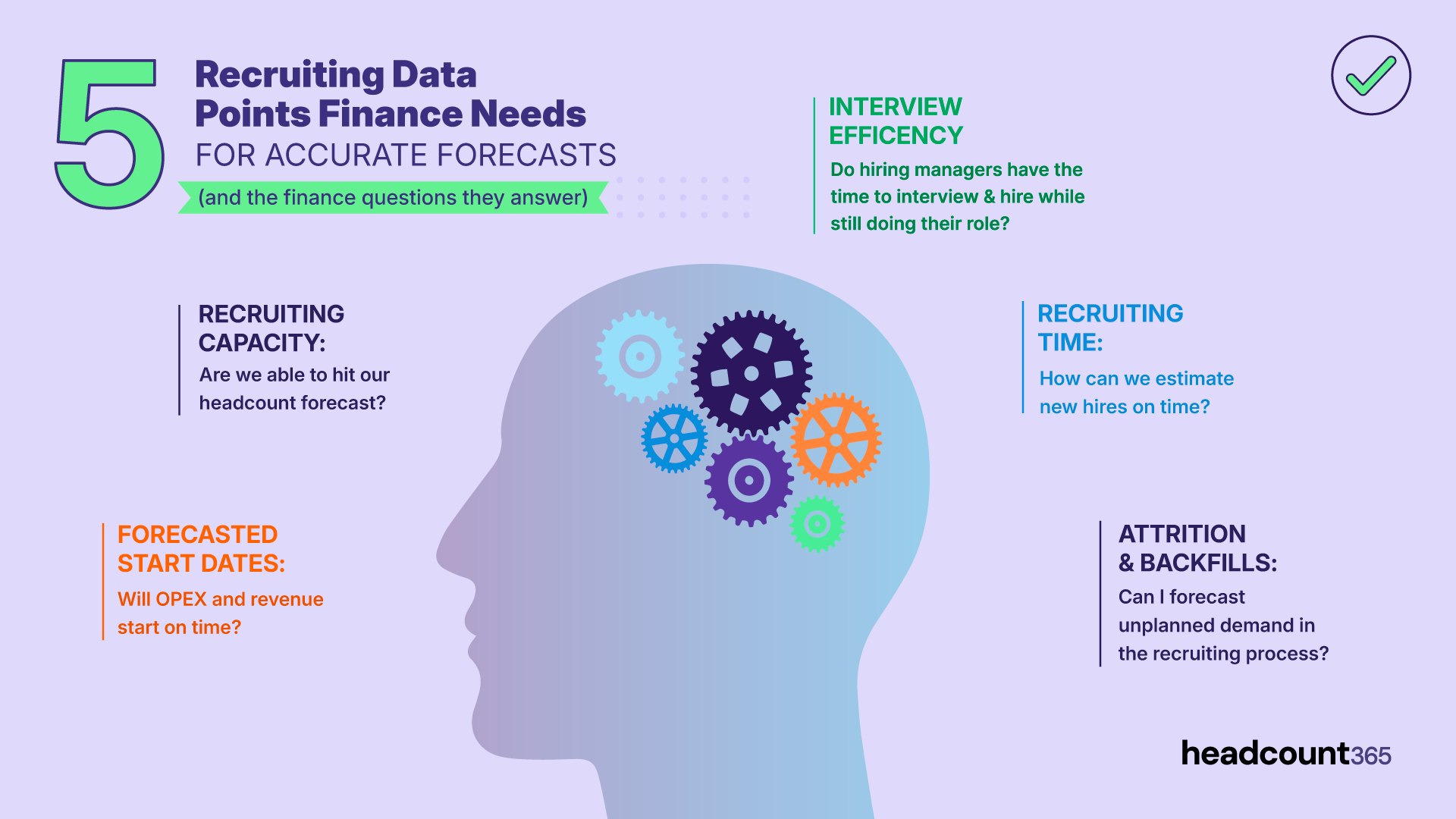
Table of Contents
5 Recruiting Data Points Finance Needs for Accurate Forecasts
To create precise financial models, Finance teams require visibility into recruiting metrics that directly impact OPEX and revenue timing.
| Recruiting Data Point | The Critical Finance Question |
|---|---|
| Interview Efficiency | Do hiring managers have the time to interview and hire while still performing their primary roles? |
| Recruiting Capacity | Are we operationally able to hit our proposed headcount forecast? |
| Recruiting Time | How can we accurately estimate when new hires will be on-boarded? |
| Forecasted Start Dates | Will OPEX (expenses) and revenue-generating activities start on time? |
| Attrition & Backfills | Can we forecast unplanned hiring demand within the current recruiting process? |
Bridging the data gap between these two departments is essential for organizational stability and growth.
Source: headcount365
For enterprise finance leaders, headcount is typically the single largest line item on the operating expense (OPEX) ledger. Yet, traditional Financial Planning and Analysis (FP&A) practices treat headcount tracking as an offline, reactive exercise.
To run an efficient, modern FP&A practice, finance leaders must establish a real-time data connection directly between the corporate budget and active recruiting pipelines. True headcount orchestration means focusing on five critical talent data points to drive absolute forecast predictability.
5 Metrics that Improve FP&A Forecast Accuracy
1. Real-Time Forecasted Start Dates
A candidate's actual start date has a direct, compounding impact on in-year operational expenses. When start dates slip, the variance cascades through payroll, benefit allocations, and departmental run-rates, leading to friction with executive boards and shareholders.
The Legacy Workaround: Finance teams often implement a manual "Feedback Friday" fire drill—forcing recruiting coordinators to audit the ATS at 3:00 PM every Friday and manually patch spreadsheets to give finance a fleeting snapshot of truth.
The Orchestrated Solution: Establishing an automated link between your systems of record feeds predictive start-date data directly into the financial ledger. Finance leaders gain continuous visibility into the in-year financial impact of every position without needing to pull manual reports or schedule reconciliation syncs.
Visit our Finance & FP&A Teams solution page to learn more about how automated data publishing stabilizes top-line forecasts.
2. Recruiting Capacity vs. Active Hiring Demand
Recruiting capacity is the baseline volume of offers a talent acquisition team can successfully close per month. Recruiting demand is the absolute number of openings the business expects them to execute. When demand spikes past internal capacity, organizations face sudden, high-cost agency spend and degraded hiring velocity.
The Legacy Workaround: Financial analysts try to build complex, Excel-based capacity planning workbooks on top of the master headcount plan. (Prior to building Headcount365, our founding team at Unicorn Talent deployed these exact models across multiple big-tech firms and as venture operating partners—they require constant manual CPR to stay accurate).
The Orchestrated Solution: A modern orchestration engine combines historical team velocity with live pipeline milestones to model an automated capacity-demand forecast. This gives finance a predictive look into upcoming capacity gaps, allowing leadership to authorize supplemental agency resources or contract recruiters before critical timelines slip.
3. Hiring Manager Interview Capacity Data
Even if a recruiting team builds a flawless top-of-funnel pipeline, a hiring plan can grind to a halt at the interview stage. Hiring managers have a fixed pool of operational hours. If a sales manager needs 35 hours a week to hit their core revenue targets, they only have 5 hours remaining for interviews. If they must interview 5 candidates per hire across 10 open requisitions, the math breaks, creating an artificial execution bottleneck.
The Legacy Workaround: Finance assumes hiring capacity is infinite, while operations teams manually track interview loops in calendars, resulting in retroactive adjustments when hiring pipelines bottleneck.
The Orchestrated Solution: Centralizing interview velocity data allows finance to factor manager availability directly into workforce models. By analyzing structural time commitments as a clear operational constraint, leadership can proactively address root-cause delivery delays before they impact top-line goals.
4. Algorithmic Time-to-Fill Velocities
Hiring velocity is highly variable across an organization. A brand-new position requires extra time to build job descriptions and interview rubrics, while executive roles demand extended notice periods. Relying on a flat, universal 45-day time-to-fill assumption across all job bands distorts cash-flow predictions.
The Legacy Workaround: Analysts manually harvest historical data from the ATS, apply a generic 15-day buffer across the board for "air cover," and hope the resulting variance doesn't spark a painful reconciliation debate during the next board meeting.
The Orchestrated Solution: Advanced headcount management engines leverage machine learning to auto-assign localized, predictive time-to-fill values to every unique requisition. The moment a business unit opens a role, the financial model updates to accurately project when that specific OPEX line item will hit the balance sheet.
This is one of many Workforce Planning & Strategies finance leaders can use to master predictive modeling.
5. The Attrition-to-Backfill Replacement Ratio
Unplanned departures create immediate, un-budgeted demand on recruiting infrastructure. If key revenue-generating roles sit vacant, the business suffers double jeopardy: lost production velocity coupled with an emergency, non-linear hiring crunch.
The Legacy Workaround: Finance applies a flat, linear attrition percentage (e.g., 1% monthly) across the global model, manually cross-referencing HR sheets weeks after an employee has already exited the building.
The Orchestrated Solution: Connecting your financial framework directly to your Human Resources Information System (HRIS) surfaces attrition trends the moment an employee submits formal notice. Automated backfill routing ensures that replacement requisitions are automatically checked against current budget constraints before being released to the talent acquisition team.
One of the key benefits of Software vs. Spreadsheets is headcount365’s ability to automatically track all terminations and backfills in a singularly linked report. This live HRIS-to-Finance syncing mitigates operational exposure.
headcount365 Shifts FP&A From Expense Tracking to Strategic Orchestration
For enterprise finance leaders, mastering recruiting data isn't just about monitoring operational expenses, it's about building an agile, predictable infrastructure for growth. By systematically tracking real-time start dates, balancing recruiting capacity, and automating attrition-to-backfill workflows, your FP&A practice moves from defensive cost-cutting to offensive capital allocation.
To explore the operational principles, structural models, and data standards that connect your financial ledger with daily recruiting execution, explore The Headcount Orchestration Methodology.