
A Recruiting Leader’s Guide to Managing On-Hold Requisitions
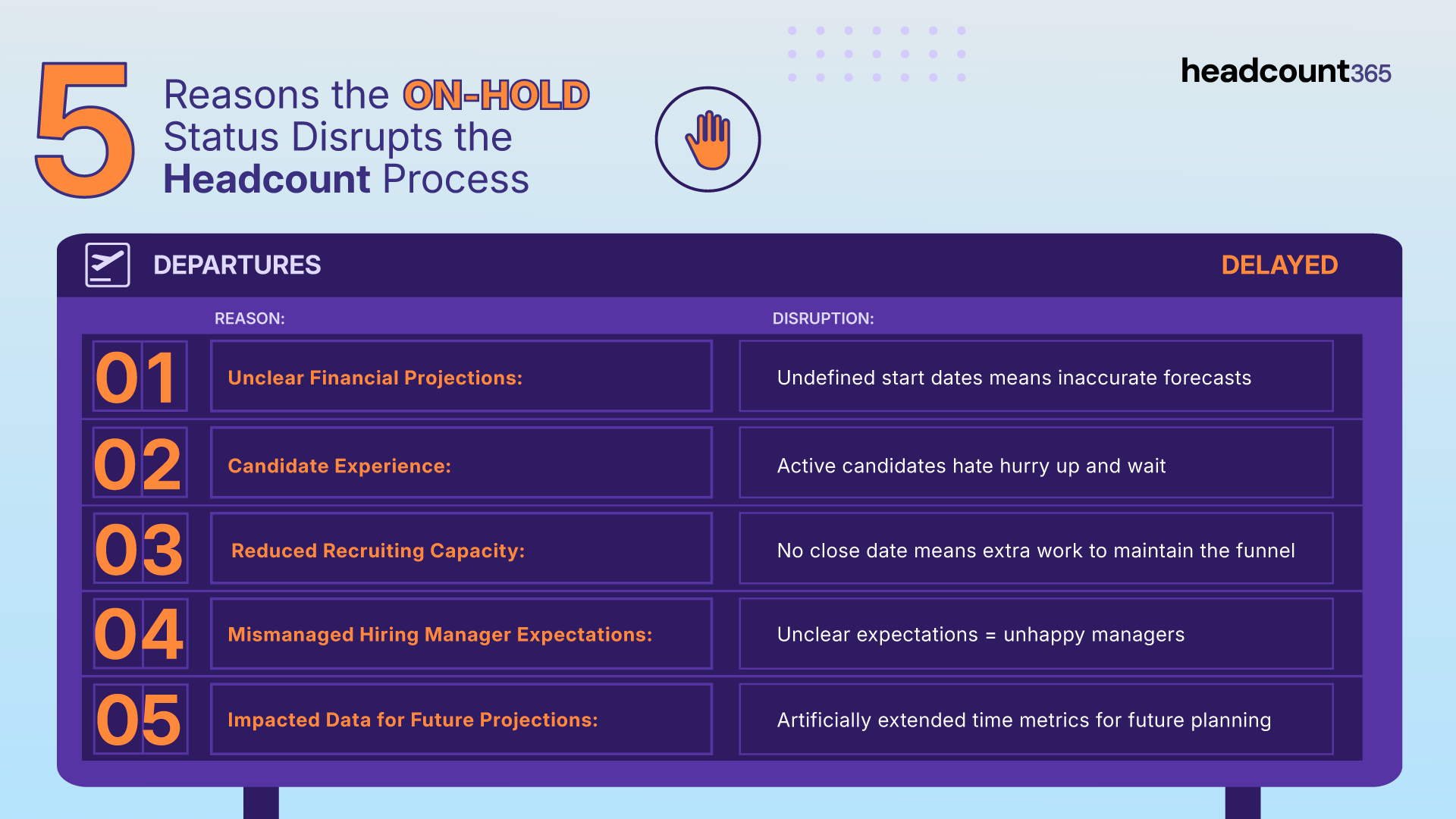
Table of Contents
5 Reasons the ON-HOLD Status Disrupts the Headcount Process
The "On-Hold" status is more than a pause; it is a significant disruption to organizational planning and execution.
| ID | Reason for Disruption | Business Impact |
|---|---|---|
| 01 | Unclear Financial Projections | Undefined start dates lead to inaccurate financial forecasts and budget misalignment. |
| 02 | Poor Candidate Experience | Active candidates are deterred by "hurry up and wait" cycles, damaging the employer brand. |
| 03 | Reduced Recruiting Capacity | A lack of close dates creates extra maintenance work for recruiters to keep the funnel active. |
| 04 | Mismanaged Hiring Manager Expectations | Vague timelines and unclear expectations result in unhappy and frustrated hiring managers. |
| 05 | Impacted Data for Future Projections | Pauses artificially extend time-to-fill metrics, corrupting historical data for future planning. |
Source: headcount365
What are on-hold, paused, or deferred requisitions?
On-hold requisitions are approved roles that have been temporarily paused, deferred, or frozen due to business, budget, or operational shifts. They occupy a transitional state between “open” and “cancelled,” influencing financial projections, recruiter workload, and candidate experience.
Modern workforce teams categorize these states differently, but all refer to the same thing.
Paused – short-term delay driven by shifting priorities.
Deferred – postponed to a future financial period.
Budget-Hold – approved role without current funding allocation.
Frozen – impacted by company-wide hiring freezes.
Pending Re-Approval – awaiting updated financial or executive confirmation.
Inactive / Suspended – technically closed or awaiting compliance review.
On-Hold & paused requisitions are vague and risky
On-hold requisitions create measurable variance in the headcount plan. They distort forecasts, delay spend alignment, and erode confidence in recruiting performance data.
When managed intentionally, hold statuses become operational signals of agility and risk—helping Recruiting, Finance, and HR course-correct together instead of working in silos.
Root causes of on-hold or deferred statuses
Budget Obligations - Companies put roles on hold to meet budget goals. If a company is hiring too fast, or spending too much against the planned hires, roles stop getting approved to hire.
The headcount365 fix: Real-Time budget & Activity Tracking for every requisition ensures businesses do not have runaway requisitionsEvergreen Role Tracking - Perpetual openings lacking budget cycle discipline. Without a unique ID per opening and a target volume, companies create the “hire until I tell you to stop” culture.
The headcount365 fix: Unique requisition IDs for every opening, synced with any ATS so the FP&A plan matches the activity in hiring manager budgets & recruiter workload.Financial Dependencies - Contingent or External Approvals Dependencies on contracts, funding rounds, or executive sign-off.
The headcount365 fix: Scenario planning modules that help unlock headcount with new sales, funding or other financial condition that would unlock headcount. Automated weekly syncs between Recruiting and FP&A unify teams around activation triggers for new headcount. Requests & approval processes ensure all teams have the right visibilityOperational or Strategic Shifts Reorganizations, new product launches, or market pivots.
The headcount365 fix: Dynamic scenario models that connect business milestones to forecast updates. A link directly to the FP&A system ensures the business knows exactly what’s happening
Key Actions to Successfully Manage On-Hold Requisitions
Use a unique identifier per job opening - On-hold requisitions tie to a line item on a budget. As hiring managers or recruiters hire, trade, or eliminate these roles, it’s important to track the activity on each requisition.
Align Holds to Financial Forecasts – Moving projected start dates to the forecasted future date helps recruiting teams manage hiring pipelines & requisition workload per recruiter, while properly resetting expectations with the hiring manager. The new forecasted start date gives finance a new budget target agreed upon by all teams.
Facilitate Clear Communication between FP&A and the business - Maintain a bi-directional data sync between FP&A and Recruiting so both teams are using the same source of truth. Alert teams of new future start dates. Headcount365’s robust integrations ensure headcount data from the business is synced with your FP&A tool
Standardize Candidate Messaging – Implement pre-approved “pause” communication workflows.
Operationalize Hold Reporting – Track hold count, average duration, and reactivation rate in leadership dashboards.
Audit Historical Data – Reconcile old holds quarterly to improve headcount accuracy and system hygiene.
Headcount365 Replaces On-Hold Ambiguity with Real-Time Requisition Tracking
Headcount365 eliminates manual reconciliation by connecting every requisition across HRIS, ATS, and FP&A systems through a single ID. The platform delivers:
Unique IDs create Real-time visibility into hold reason codes and duration
Start date predictions help finance teams forecast start dates that meet budget objectives
Collaboration between Recruiting and Finance through live plan tracking
Historical analytics on plan change rate and reactivation probability
The result is fewer on-hold requisitions, faster financial alignment, and stronger trust between HR, Finance, and Recruiting leadership.
Requisition holds are not administrative friction, they are diagnostic signals of system misalignment. Companies that measure and operationalize them gain foresight into business readiness, budget efficiency, and recruiter capacity. Managing them through unified data turns disruption into a predictable input for smarter, more resilient workforce planning.